

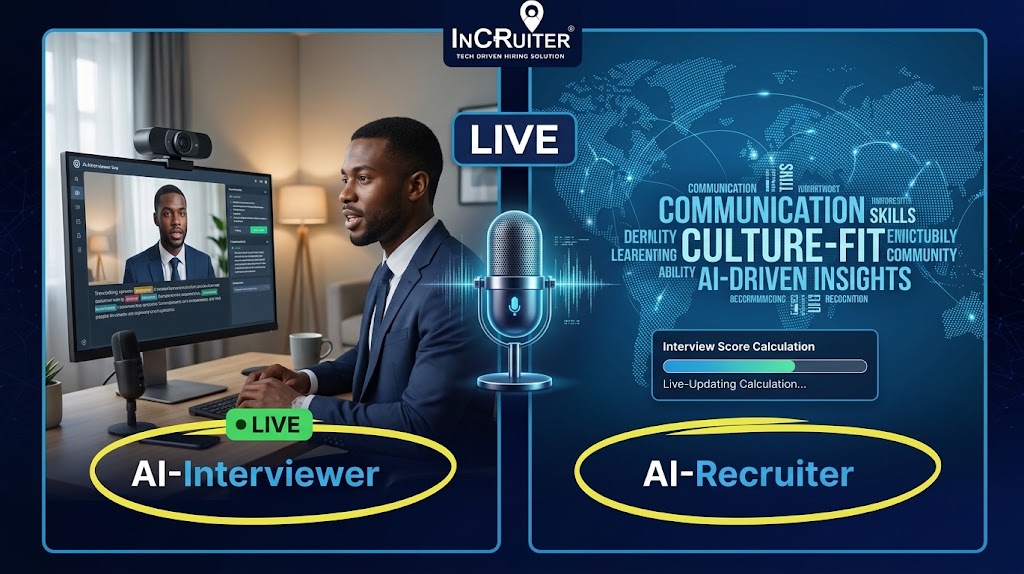
AI interviews are becoming part of recruitment, but applicants should prepare for the job, not try to game an algorithm and understand how AI influences the hiring decision.
Recruiters Are Using AI Interviews, What Job Applicants Should Expect
Your next job interview may begin without a human interviewer. AI is increasingly being used to ask questions, analyse responses and help recruiters screen candidates but applicants need to understand what the technology is actually doing.
Recruiters are increasingly using artificial intelligence before a candidate ever speaks to a human hiring manager. An “AI interview” can mean several different things: a recorded video response analysed by software, a voice based bot that asks follow-up questions, or a normal human interview where AI takes notes and helps recruiters compare answers. The trend is moving quickly.
The Greenhouse 2026 Candidate AI Interview Report, based on 2,950 job seekers across the US, UK, Ireland, Germany and Australia, found that 63% of US respondents had already experienced an AI interview. Meanwhile, SHRM's research on AI in recruitment reports that 51% of organisations use AI in recruitment. For applicants, the important question is no longer simply whether AI might appear during hiring. It is what role the system is actually playing.
“AI interview” can mean very different things
The simplest version is an asynchronous video interview. Instead of meeting a recruiter, you receive questions on screen and record your responses. Software may then transcribe, organise or help assess those answers before a recruiter reviews them.
A newer version is conversational AI. HireVue, for example, launched a voice-based AI Interviewer in June 2026 designed to conduct dynamic, skills-focused conversations rather than simply present a fixed sequence of prerecorded questions. There is also a less obvious form.
A human interviewer may still be speaking to you while AI produces notes, summaries or candidate insights in the background. That distinction matters because “AI was used” does not necessarily mean a machine made the hiring decision.
What might the system be looking for?
Candidates should avoid assuming there is a secret set of robotic phrases that guarantees a good score. Employers can configure interview systems around different competencies, questions and job requirements. Some tools primarily structure or summarise what you say, while others can help evaluate responses against predefined criteria.
The safest preparation therefore looks remarkably similar to preparation for a human interview: Understand the role, know your own experience, be ready to explain specific examples.
A strong answer should make clear what happened, what you were responsible for, what you did and what changed as a result. The familiar STAR method: Situation, Task, Action and Result, can help organise those answers without making them sound memorised. What is less useful is trying to “speak to the algorithm” by stuffing answers with keywords or reading an AI-generated script word for word. That can make an interview sound unnatural and leave you poorly prepared if the system or a human recruiter later asks a follow-up question.
The interview may feel surprisingly impersonal
For some applicants, the biggest adjustment will be psychological. There may be nobody smiling, nodding or asking you to clarify a point. You might instead be speaking directly to a camera, watching a countdown timer or answering questions from an automated voice.
Greenhouse's 2026 research found significant discomfort around this shift. Among surveyed US candidates, 38% said they had already withdrawn from a recruitment process because it included an AI interview. Lack of disclosure and interviews involving no visible human participation were among the concerns candidates identified. That does not mean every automated interview is unfair. It does show why applicants increasingly want employers to explain when AI is being used and whether a person remains involved in important decisions.
Nigerian applicants should pay attention to automated decisions
This matters for Nigerians applying both to local companies and international remote positions. An AI interview can involve personal information including your voice, image, answers, employment history and other information supplied during recruitment.
Nigeria's Data Protection Commission lists the right not to be subjected to automated decision-making among the protections available to data subjects. More specifically, Section 37 of the Nigeria Data Protection Act 2023 addresses decisions based solely on automated processing of personal data that produce legal or similarly significant effects. Where those protections apply, safeguards can include obtaining human intervention, expressing your point of view and contesting the decision.
That does not mean every use of AI during recruitment is prohibited. But it is a strong reason to read privacy notices and understand whether automated evaluation merely assists recruiters or substantially determines what happens to your application.
How to prepare without trying to game the system
Start with the ordinary problems that can ruin any remote interview: poor audio, unstable internet, bad lighting and unfamiliar software. Test your microphone and camera beforehand. If answers are timed, practise explaining yourself clearly without turning every response into a rushed speech. Then prepare examples from your real experience. Have situations in mind that demonstrate problem solving, teamwork, initiative, conflict handling and the technical or professional skills relevant to the position.
If the employer says AI will record or evaluate the interview, read the accompanying privacy information. Look for what information is collected, why it is required and whether humans review the result. And if the process is unclear, asking the recruiter is reasonable: How is AI being used in this interview, and will a person review the outcome? That is a more useful question than trying to discover imaginary tricks for beating the software.
Our Recommendation
Treat an AI interview as a real interview, not as a puzzle that needs to be hacked. Prepare for the position rather than for an imagined algorithm. Give specific and truthful answers, make sure your technology works and understand what the employer says AI is doing with your responses.
The technology may change the person or machine asking the questions. It does not change the value of being able to explain clearly what you know, what you have done and why you are a strong fit for the job.
Verification Links
- Greenhouse — 2026 Candidate AI Interview Report
- Greenhouse — 2026 AI in Hiring Report
- SHRM — How AI Is Reshaping Talent Acquisition in 2026
- SHRM — The Rise of the AI Interviewers
- HireVue — AI Interviewer Announcement
- Nigeria Data Protection Commission
- Nigeria Data Protection Act 2023
How TechView Africa verifies this article
TechView Africa reviewed current recruitment research from Greenhouse and SHRM, product documentation from HireVue and the Nigeria Data Protection Act 2023. Claims concerning automated hiring and candidate privacy were checked against primary or authoritative sources, with distinctions maintained between AI-assisted recruitment and decisions made solely through automated processing. Information was last verified on 24 August 2026.
Frequently asked questions
Frequently Asked Questions
What is an AI job interview? An AI interview is a recruitment process where artificial intelligence assists with tasks such as asking questions, recording or transcribing responses, conducting conversational interviews, summarising answers or helping recruiters evaluate candidates.
Does AI decide whether I get the job?
Not necessarily. Some systems only assist recruiters, while others can play a larger role in screening or evaluating candidates. Applicants should check any information supplied by the employer about how AI is used and whether humans review the outcome.
Can AI analyse my face or voice during an interview?
Interview technologies differ substantially. Applicants should not assume every system analyses facial expressions, emotions or vocal characteristics. Check what the specific employer or platform says it collects and evaluates.
Should I use AI to generate answers during an AI interview?
Using AI beforehand to practise possible questions can be useful, but relying on generated answers during the actual interview can produce generic or inaccurate responses and may violate an employer's interview rules. Your answers should reflect your real experience.
How should I prepare for an AI interview?
Research the position, prepare specific examples from your experience, test your camera and microphone, practise answering clearly and read any information explaining how the employer uses AI.
Do Nigerians have rights concerning automated recruitment decisions?
The Nigeria Data Protection Act 2023 contains protections relating to decisions based solely on automated processing that produce legal or similarly significant effects. The precise application depends on the circumstances, so candidates dealing with a consequential automated decision should consult the relevant official guidance.
Follow TechView Africa on WhatsApp
Get TechView Africa updates on WhatsApp. Follow our channel for practical technology news, product guides and digital trends from Nigeria and across Africa.

Leave a comment
Comments cannot be edited or deleted after posting. Please review your comment before submitting.
No approved comments yet. Start the conversation.