

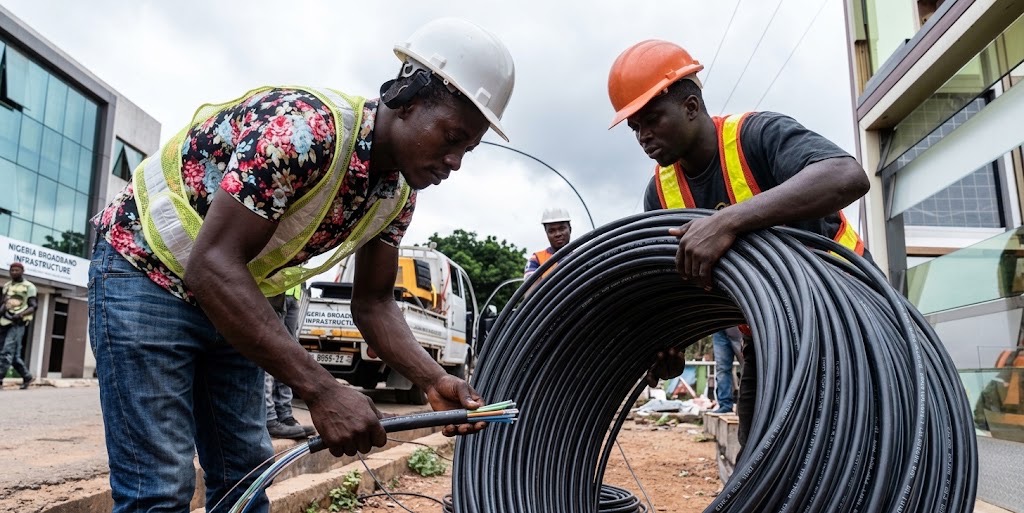
Nigeria Has 192 Million Active Phone Lines. Fixed Fibre Connections Are Still Below 320,000
Nigeria’s fibre market is growing quickly, but new NCC data shows just how heavily the country still depends on mobile networks for internet access.
Nigeria recorded 192.23 million active telephone subscriptions in June 2026, while Fibre-to-the-X subscriptions reached only 319,735 in Q2. Fibre grew more than 32% in one quarter, but fixed connectivity remains tiny compared with the scale of the mobile market.
Nigeria’s internet economy is growing rapidly, but the infrastructure carrying that demand remains heavily tilted towards mobile networks. The Nigerian Communications Commission’s latest industry statistics recorded 192,232,120 active telephone subscriptions in June 2026. By comparison, Fibre-to-the-X connections—including fibre reaching homes, offices and other endpoints—stood at only 319,735 in the second quarter.
Those numbers should not be treated as directly equivalent: one person can own multiple mobile lines, and an FTTX subscription can serve an entire household or business. But the difference still reveals something important about Nigeria’s connectivity model. For most people, the mobile network remains the internet network.
Fibre is actually growing quickly
The 319,735 figure can make Nigeria’s fixed-fibre market look almost static beside 192 million telephone connections, but that misses an important development.
NCC data shows FTTX subscriptions increased from 241,750 in Q1 to 319,735 in Q2, an addition of nearly 78,000 connections in three months and growth of roughly 32%. The regulator defines FTTX as fibre extending to destinations including homes, offices, streets and buildings rather than FTTH alone. So the problem is not that fibre is failing to grow. It is that it is growing from an extremely small base.
That broader fixed-broadband market is expanding too: Afritech Connect’s analysis of Nigeria’s ISP market found that active ISP subscriptions rose 19.6% in six months, although the market remains concentrated among a relatively small number of providers.
That matters as Nigerians consume increasingly large amounts of data. NCC statistics show internet traffic reached about 1.53 million terabytes in June and rose again to 1.66 million terabytes in July.
TechView Africa previously found the same pressure across the continent in our analysis of Africa’s rapidly rising mobile-data consumption. More streaming, social media, cloud storage, video calls and AI services mean networks must carry substantially more traffic even without equivalent growth in the number of users.
Why fixed fibre changes the experience
Mobile broadband is remarkably effective at connecting large populations without running a cable into every building, but users share finite radio capacity.
That becomes important in busy areas where large numbers of people are simultaneously streaming video, downloading files or using cloud services. Expanding fibre can give homes and businesses dedicated high-capacity connections while also providing the backhaul mobile networks themselves need.
For remote workers, creators and businesses regularly transferring large files, the difference can be particularly noticeable. Gaming, 4K streaming, cloud backups and always-connected devices also benefit from stable fixed broadband.
Nigeria is simultaneously expanding faster mobile technology. As TechView Africa explained in our look at Airtel’s growing Nigerian 5G network, faster radio networks can improve what consumers experience, but coverage and underlying infrastructure still determine whether those theoretical speeds become useful connections.
Nigeria needs mobile and fibre, not one or the other
The 192 million versus 320,000 comparison should therefore not be interpreted as evidence that Nigeria ought to replace mobile broadband with fibre. The two increasingly depend on each other.
Mobile networks remain the fastest practical way to connect millions of people across a geographically large country. Fibre, meanwhile, can provide high-capacity fixed connections while strengthening the underlying infrastructure that mobile towers rely on.
Nigeria’s latest figures consequently tell two stories at once: fibre adoption is accelerating, but the country remains overwhelmingly mobile-first.
As internet usage grows and applications become more demanding, closing that infrastructure gap will determine whether Nigerians simply consume more data or receive connections capable of handling everything they increasingly expect the internet to do.
Our Recommendation
Nigeria does not have a fibre-growth problem so much as a fibre-scale problem: connections are increasing quickly, but mobile networks still carry the overwhelming weight of the country’s digital activity.
Verification Links
Nigerian Communications Commission — Industry Statistics
The Guardian — Nigeria’s mobile and fibre subscription figures
Frequently asked questions
Does Nigeria have only 320,000 fibre-connected homes?
No. The NCC figure is FTTX, which includes fibre delivered to homes, offices, streets and other endpoints, so it should not be described strictly as 320,000 households.
Did fibre subscriptions increase in Q2 2026?
Yes. They rose from 241,750 in Q1 to 319,735 in Q2, an increase of about 32%.
Are 192 million phone connections the same as 192 million Nigerians?
No. These are active subscriptions, not unique individuals; one person can maintain more than one SIM or connection.

Which Internet Network Is Fastest in Nigeria? What 200,000+ Speed Tests Reveal
Nigeria Licensed Dozens of New Mobile Networks — So Why Haven’t Most Consumers Seen Them?
Why Does Your Mobile Data Finish So Fast

MTN Expands Beyond Telecoms Into Banking and AI Infrastructure

Africa’s Data Use Is Surging - What That Means for Networks, Prices and Consumers
Airtel’s 5G Push Is Accelerating in Nigeria: Will Your Current Phone Actually Benefit
Should We Slow Down AI? The Human Control Question Behind Autonomous Weapons, AI Agents and Superintelligence
Follow TechView Africa on WhatsApp
Get TechView Africa updates on WhatsApp. Follow our channel for practical technology news, product guides and digital trends from Nigeria and across Africa.
Leave a comment
Comments cannot be edited or deleted after posting. Please review your comment before submitting.
No comments yet. Start the conversation.