

AI agents can make business data easier to analyse, but their security depends on the permissions they receive, how information is stored and shared, and the controls businesses enforce. Before connecting an agent to sensitive systems, companies should restrict access, verify its outputs and retain human oversight.
AI agents can make company information easier to use, but connecting one to a business database does not automatically make the information safe. For businesses assessing AI agent security, the important questions are what the agent can access, whose permissions it uses, which other services receive the data, how long information is retained and whether administrators can monitor its activity.
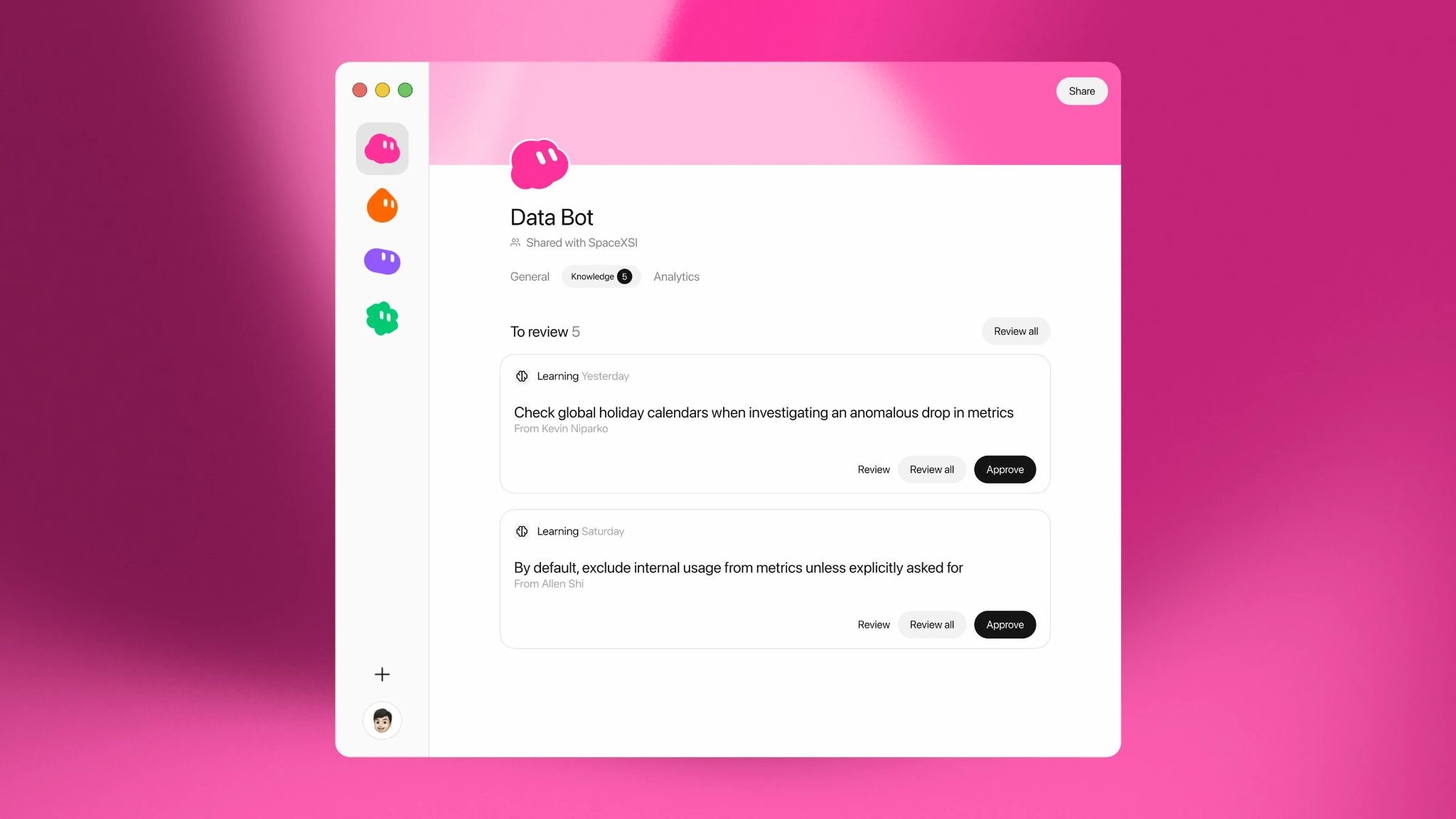
SpaceXSI's Data Bot, an internal AI assistant built using Grok Bot, provides a useful example. The company says its data science team configured the shared bot to query its data warehouse, investigate business metrics, analyse experiments, create charts and dashboards, and provide reports through Slack.
The opportunity is clear: employees can investigate business questions without waiting for a data specialist to handle every request. The security implications, however, depend on how the connections and permissions are configured. SpaceXSI's public account describes what Data Bot does, but it does not disclose enough about its actual warehouse permissions to establish that every part of the arrangement is safe.
For businesses considering similar AI agents, the more useful question is not simply whether the provider offers encryption or access controls. It is whether the organisation can restrict, understand and supervise what the agent does with its information. This is the central concern behind AI agent data security and business data security with AI agents.
What Is Grok Bot's Data Bot, and How Does It Work?
SpaceXSI introduced Data Bot in a 2 November 2026 post titled Giving every team a data scientist with Grok Bot. It describes the system as a shared bot for Grok Bot team analytics, which the company's data science team has taught to work with its internal data and established analytical methods.
The team supplies skills covering business metrics, source tables, query logic, experiment analysis, charts, dashboards and data engineering conventions. This allows employees to ask questions in ordinary language while the bot uses the team's existing analytical knowledge to investigate them.
For example, a product manager can ask why the use of a feature has changed, while a marketing employee can examine what customers did after interacting with a campaign. The bot can investigate possible explanations, produce charts and reports, and build dashboards that colleagues can continue using. Teams can also add it to Slack channels, where it can respond to questions and provide scheduled updates.
Data Bot also has shared memory. SpaceXSI says the system can propose new information based on day-to-day use, such as which colleague manages a particular data pipeline or whether a previous change in a business metric coincided with a regional holiday. Its managers review those proposed additions before approving them for wider use.
SpaceXSI estimates that Data Bot handled approximately 70 hours of work during the week before its announcement that would otherwise have gone to its data science team. This is the company's estimate, not an independently measured productivity result. The announcement does not provide the calculation method or establish the financial savings other organisations should expect.
SpaceXSI's current Team Bots page also lists Data Bot as a pre-built analytics Bot. The company says it uses shared, read-only credentials to query approved tables in Databricks and connects to Datadog, Hex and Statsig. This provides more specific information about its data access than the original case study, although other organisations would still need to assess their own datasets, permissions and governance arrangements.
What Security Features Does Grok Bot Offer Businesses?
Grok Bot security features described in its published security documentation include safeguards intended to control access, separate users and restrict potentially harmful actions. These Grok Bot security controls are useful, but businesses need to understand what each one protects and which account plans include it.
User-level computer isolation
The documentation says each user's work runs on a dedicated hosted computer built around a Firecracker micro-virtual machine. This is intended to isolate one user's computing environment from another's.
However, the same user's Bots share that computer. Files, browser sessions and other resources available in that environment may therefore be accessible to the user's other Bots. Creating separate Bots does not automatically create separate security environments for their owner.
Controls for shared Bots
A shared Bot can be made available to an entire team or selected colleagues and groups. Its owner and designated managers can configure its instructions, applications, secrets, skills and files. Other authorised users can interact with it as collaborators, while managers can also change how it works.
Grok Bot's documentation says individual conversations with a shared Bot are private: the owner and managers cannot read another teammate's conversations. However, the resources deliberately configured for the shared Bot are intended to be available to the people who can use it. The Bot can also maintain shared memory for the team.
Every shared Bot uses the applications and secrets its owner has added. In an individual chat, it can also use the requesting teammate's connected applications, but it must ask for permission before using that person's account. In Slack channels, threads and group chats, it uses the owner's applications and asks before using the account of the person it is answering. A connected account always acts as the person the Bot is answering; one teammate's connection is never used for another.
Businesses should therefore review the permissions attached to the owner's shared resources as well as the individual accounts colleagues may authorise. Private conversations do not mean that every connected resource is separately configured for each user. These arrangements are central to shared AI agent security, particularly where colleagues have different roles and data-access requirements.
These arrangements make AI agent access control an important consideration. The security of Grok Bot shared Bots depends not only on who can open a Bot, but also on which applications, credentials, files and other resources are made available to its users.
Human approval and action review
Grok Bot uses an Auto Review system to assess potentially risky actions and can require a person to approve them before they proceed. Users can also establish rules requiring approval for particular actions.
These controls can reduce the chance of an agent carrying out an unintended operation, but they do not replace restricted permissions. The documentation also notes that Auto Review does not examine every possible side effect, including memory writes and many settings changes.
Administrative oversight
The product documentation distinguishes administrative audit logs from Action Recording. Audit logs cover administrative, security and authentication events. Action Recording captures information about Bot activities, including tool calls, browser navigation and computer-use sessions.
For businesses evaluating AI agent audit logs, it is important to understand that these are separate monitoring systems. However, both are listed as Enterprise-only controls. Action Recording is a separate setting and is off by default; the documentation describes a 90-day retention period for its recorded events. Businesses should not assume that every deployment automatically provides the activity records their security or compliance teams may require.
Network Controls, which allow administrators to restrict the destinations a hosted computer can reach, are also Enterprise-only. The documentation says teams without a network policy default to allowing all network access. These plan restrictions are relevant to Grok Bot enterprise security assessments because they determine which safeguards an organisation can actually configure.
AI Agent Security Risks: What Businesses Should Know
Several AI agent security risks remain even when encryption, isolated computing environments and approval controls address important parts of security. These measures do not establish that an agent has been given the correct permissions or that every answer it produces is accurate.
Consider a business that connects an analytics agent to its data warehouse. A marketing employee may need campaign performance figures, but the connection might also expose customer-level records or confidential revenue information. If the underlying database permissions are too broad, the agent could retrieve information beyond what the employee needs for the task. This creates a risk of AI agent data leakage, even when the agent is operating as configured.
SpaceXSI's current Team Bots description says Data Bot uses shared, read-only credentials to query approved Databricks tables. It also connects to Datadog, Hex and Statsig. However, the public description does not explain how the approved tables are selected, whether sensitive fields or row-level restrictions are applied, or how access to query results is governed for different employees. Read-only access prevents the configured credentials from writing to the approved data sources, but it does not by itself prevent the agent from disclosing information it is authorised to read.
Businesses should also consider AI agent prompt injection. This occurs when instructions hidden in material an agent reads, such as webpages, documents or application results, attempt to influence its behaviour. An agent with access to connected systems may be exposed to instructions that were not written by the user who started the task.
Grok Bot's documentation describes multiple protections, including Auto Review, network restrictions, approval prompts and user-level isolation. It also acknowledges that these measures reduce rather than eliminate the risk. Sensitive actions should therefore remain subject to deliberate human approval, particularly where they could expose information, change production systems or send communications outside the organisation.
Another concern is analytical reliability. An agent can retrieve the correct information and still interpret it incorrectly. A report may use an outdated metric definition, overlook a change in data collection or mistake a correlation for an explanation. Companies should validate the underlying queries and compare consequential results against trusted reports.
For teams building retrieval-augmented generation (RAG) applications, AfriTech Connect's guide to evaluating RAG systems in production explains why retrieval quality, grounded answers and ongoing testing must be assessed separately. SpaceXSI has not identified Data Bot as a RAG system, so those methods should not be mistaken for a description of its architecture.
Grok Bot Privacy, Data Processing and Retention
AI agent data privacy depends not only on what appears on the screen but also on where information goes after an employee submits a request.
Grok Bot's security documentation describes a service architecture in which requests pass through Cursor's servers, work runs on hosted computers, prompts go to model providers and tool calls reach third-party services through connected applications. This means that a business should identify the actual service providers and sub-processors involved in its deployment, rather than assume that a single product name describes the entire data-processing chain.
Grok Bot privacy settings include controls relating to model training and data handling. The documentation says that, with Privacy Mode enabled, customer data is not used for model training. It also explains that Zero Data Retention follows existing agreements with model providers. Providers may still operate abuse and safety systems, and information flagged for investigation may be retained.
Businesses assessing Grok Bot data privacy should not interpret these statements as a promise that no information is stored anywhere in the wider service. They address particular model-training and provider-retention arrangements, while other parts of the platform, connected applications and hosted environments have their own data-handling considerations. The Data Bot announcement does not disclose which privacy settings or contractual arrangements were used for SpaceXSI's particular deployment.
Businesses assessing Grok Bot data retention should therefore examine the relevant arrangements across the model providers, connected applications and hosted environments. Data location also deserves attention. The current documentation describes Grok Bot's hosted computers as running in the United States and says on-premises deployment, deployment inside a customer's own perimeter and bring-your-own-image deployment are not currently supported. This does not establish the location of every model-provider or connected-application operation. Organisations with data-residency requirements should obtain a clear account of the complete processing route and relevant contractual commitments before adoption.
For a broader discussion of how AI and connected services affect personal information, see AfriTech Connect's article on data privacy concerns as AI continues to advance.
What African Businesses Should Consider
For African businesses, AI agents could make data analysis more accessible to teams that cannot maintain a large in-house data science function. A retailer might examine sales patterns, a logistics company could investigate delivery delays, and a digital agency could compare campaign performance.
These uses do not remove the organisation's responsibility for the information it processes. In Nigeria, businesses that connect agents to customer, employee or other identifiable personal information should assess their obligations under the Nigeria Data Protection Act 2023. The relevant requirements depend on the organisation's role, the purpose and nature of processing, the information involved and the service providers handling it.
Using an external AI service does not, by itself, settle who is responsible for the personal data or whether the processing arrangements are appropriate. Organisations should establish the roles of the parties, review contractual safeguards, understand any international data transfers and restrict access to information that is not required for the task.
TechView Africa's guide to NDPC registration in Nigeria and the obligations that apply to businesses explains why registration status and wider data-protection compliance should not be treated as the same thing.
Businesses operating in other African countries should assess the relevant national laws and regulatory requirements separately. A service's technical availability does not establish that every proposed use is suitable under every country's data-protection framework.
Our Recommendation
Businesses should not give an AI agent unrestricted access to a production data warehouse simply because it can answer analytical questions. For businesses asking how to secure AI agents, the safer approach is to start with a limited task and make the boundaries clear before connecting sensitive information. This is a practical foundation for AI agent security for businesses.
First, identify the exact datasets the agent needs. Where possible, expose approved views or restricted datasets rather than the entire warehouse. Use a dedicated account with the narrowest permissions required, preferably read-only for analytical work. Enforce access restrictions at the database level; do not assume the agent will automatically reproduce every employee's existing permissions.
Second, decide who can use and manage the shared Bot. Review its connected applications, files, skills, secrets and shared memory before inviting colleagues. Give management rights only to people responsible for maintaining the configuration, and review access when employees change roles or leave.
Third, confirm the security controls available on the actual subscription. Businesses that require network restrictions, administrative audit logs, Action Recording or enforced Auto Review should establish whether their plan supports those features and whether the relevant controls have been enabled. They should also understand what each log records and how long the information is retained.
Fourth, ask the provider for clear contractual answers about privacy settings, model providers, sub-processors, retention, deletion, processing locations and incident handling. Confirm that the arrangements meet the organisation's legal, contractual and internal requirements before uploading personal or commercially sensitive information.
Finally, test the system with controlled data before allowing it to influence consequential decisions. Check whether it can retrieve information outside its intended scope, whether its answers match trusted records, and how it responds to misleading instructions in content it reads. Keep a human responsible for reviewing important analytical conclusions and approving actions that could affect customers, finances or production systems.
Data Bot demonstrates how a company can package specialist analytical knowledge into a shared AI agent and make it available across teams. It does not establish that the same design is automatically secure for every organisation. A business should judge the deployment by the permissions it grants, the data flows it accepts, the controls it can monitor and the accountability it retains, not simply by the quality of the agent's answers.
Frequently asked questions
1. Is Grok Bot's Data Bot available for businesses to use?
SpaceXSI's announcement describes Data Bot as an internal shared AI agent developed by its data science team. It does not establish that the same implementation is available as a ready-made commercial product for other businesses.
2. Can the owner of a shared Grok Bot read other users' conversations?
According to Grok Bot's documentation, individual conversations with a shared Bot remain private from its owner and managers. However, the Bot's shared applications, files, secrets, skills and approved memory are configured for use by authorised collaborators.
3. Does enabling Privacy Mode mean Grok Bot stores no business data?
No. Privacy Mode addresses the use of customer data for model training. Data retention, abuse monitoring, connected applications and other parts of the service have separate arrangements. Businesses should review the provider's retention and processing terms rather than interpret Privacy Mode as a guarantee of zero data storage.
4. Does Grok Bot automatically apply each employee's database permissions?
The public Data Bot announcement does not explain how its warehouse permissions are configured or whether queries run under individual employee identities. Businesses should enforce access restrictions within the underlying database and verify that the agent cannot retrieve records beyond the user's authorised scope.
5. Are Grok Bot's audit logs and Action Recording available on every subscription?
No. The product documentation identifies audit logs and Action Recording as Enterprise-only features. Action Recording is also off by default. Businesses that require these capabilities should confirm their availability and configuration before deployment.
ChatGPT Ads Arrive in Nigeria: What ₦3,250 a Day Really Means
Google and AWS Are Making AI Chips Easier to Use. Is NVIDIA’s Software Advantage Narrowing?

Microsoft’s Medical AI Scored 83% on Difficult Cases. Could It Help Nigeria’s Hospitals?

INEC Has AI Safeguards, But Who Verifies Compliance?
MORENA AI Supports 12 African Languages, but How Accurate Is It?
What Should Your Business Fix First? A Practical Guide to Analysing Customer Feedback With AI
From Idea to Clickable Prototype: How to Test a Product With AI Before You Build It
Follow TechView Africa on WhatsApp
Get TechView Africa updates on WhatsApp. Follow our channel for practical technology news, product guides and digital trends from Nigeria and across Africa.
Leave a comment
Comments cannot be edited or deleted after posting. Please review your comment before submitting.
No comments yet. Start the conversation.