

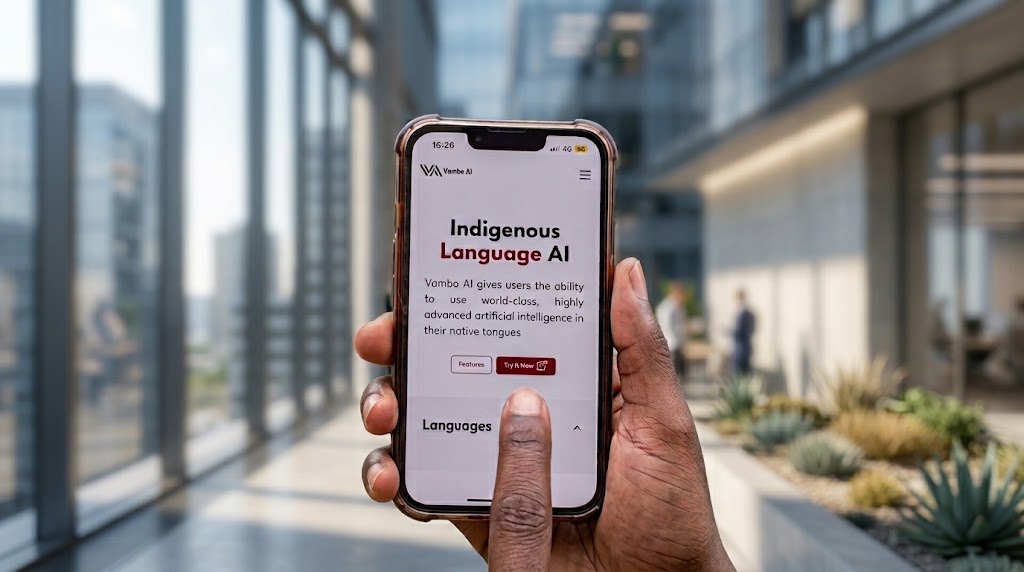
MORENA demonstrates the value of building AI around African-language data and tokenisation. Its reported efficiency gains are promising, but reliable everyday use still depends on independent testing and native-speaker evaluation.
MORENA AI Supports 12 African Languages. Can It Understand Them Reliably?
*MORENA is an open-weight language-model family developed by South African startup Vambo AI. Their 1.5-billion-parameter models are designed for 12 African languages, alongside English and French, but their performance varies across translation, comprehension and factual tasks. *
South African startup Vambo AI has developed MORENA, a family of artificial intelligence models designed to process 12 African languages, including Hausa, Yoruba, Igbo and Nigerian Pidgin.
Its flagship 1.5-billion-parameter model was trained from scratch, rather than simply adapting an existing international AI model. The project was released in September 2026 and subsequently attracted wider attention in October.
MORENA addresses a persistent problem: AI systems may recognise African languages without consistently understanding their dialects, expressions or cultural context.
For Nigerian developers, the important question is whether a model designed around local languages can offer practical advantages over larger, general-purpose alternatives.
Which African languages does MORENA support?
According to Vambo AI's model documentation, MORENA targets the following languages:
| Language group | Supported languages |
|---|---|
| Nigerian languages | Hausa, Yoruba, Igbo, Nigerian Pidgin |
| Other African languages | Swahili, Kinyarwanda, Shona, isiZulu, isiXhosa, Setswana, Afrikaans, isiNdebele |
The geographical grouping highlights Nigerian relevance; these languages are not necessarily confined to particular countries. The models also process English, French and programming code.
This coverage matters because everyday communication often involves switching between languages, informal spelling and regional expressions.
However, language support does not guarantee accurate comprehension. TechView Africa previously explored this distinction in its analysis of how reliably AI understands African languages.
What makes MORENA different from other AI models?
MORENA's development places particular emphasis on training data and tokenisation. A tokenizer breaks written text into smaller units before an AI model processes it. When a tokenizer is poorly suited to a language, it may require more tokens to represent the same message.
Vambo AI reports that its tokenizer processes the evaluated African-language text using approximately 1.39 times fewer tokens than Gemma 3's vocabulary and 1.53 times fewer than Llama 3.2's.
This could make some local-language applications more computationally efficient, although actual costs depend on hardware, workload and deployment.
The MORENA family also includes smaller 500-million-parameter and 200-million-parameter variants intended for different technical applications.
How accurate is MORENA AI?
The published benchmarks show encouraging results, but not across every task. Vambo AI reports that its 1.5-billion-parameter instruction-tuned model achieved a chrF++ translation score of 45.8 when translating English into five evaluated African languages, compared with 37.8 for MADLAD-400-3B.
In the opposite direction, MORENA scored 48.7, while MADLAD-400-3B achieved 53.6. These results show why describing MORENA as universally superior would be misleading. Translation accuracy depends on language, direction and testing conditions.
The base model also recorded a reported average of 1.408 bits per byte across the 12 African languages, the lowest among 26 models evaluated. This measures language prediction efficiency, not whether every answer is factually correct.
The developers acknowledge limitations in factual reliability and aspects of safety evaluation. Independent assessments involving fluent speakers are still necessary.
What could MORENA mean for Nigerian businesses and developers?
MORENA's most practical potential lies in applications where local-language processing matters. A Nigerian customer-service provider, for example, could investigate whether the model can classify complaints written in Pidgin, Yoruba or Hausa. Educational developers might explore translation exercises and local-language learning materials.
Researchers could also evaluate how it handles code-switching, slang and regional expressions. The model weights are available through Hugging Face under the Apache 2.0 licence, permitting commercial use subject to the licence terms.
However, access to model weights does not mean a ready-made consumer application exists. Developers still need suitable computing resources, integration work and performance testing.
For businesses, this connects directly with TechView Africa's guide to analysing customer feedback with AI, which explains why local expressions and ambiguous complaints require human review.
Can MORENA help close Africa's AI language gap?
MORENA provides evidence that African-language requirements can shape the underlying design of AI systems rather than being added as an afterthought.
But significant questions remain about dialect coverage, culturally specific expressions, mixed-language conversations and factual accuracy.
Its training also used substantial machine-translated material, which may not fully represent how people naturally communicate.
The next meaningful measure of progress will be whether independent researchers can demonstrate dependable performance in real African-language applications.
Our Recommendation
Nigerian developers, universities and businesses should consider MORENA for controlled experiments involving translation, education and customer communication.
Start with a narrowly defined task, evaluate real examples and involve fluent speakers before deploying it to users.
MORENA is a promising technical contribution, but its benchmark results should not be mistaken for proof of universal language understanding.
Sources & Verification
MORENA 1.5B Base Model — Technical Documentation
MORENA 1.5B Instruction Model — Benchmarks and Limitations
Frequently asked questions
Is MORENA AI free to use?
Its published model weights are available under the Apache 2.0 licence. Running, adapting or hosting the model may still involve computing costs.
Does MORENA understand Nigerian Pidgin?
Nigerian Pidgin is one of its supported languages, but accuracy may vary with slang, regional expressions and the task being performed.
Is MORENA better than ChatGPT or Gemini?
Its published benchmarks show advantages on selected African-language tasks. They do not establish that MORENA is generally better than ChatGPT, Gemini or other AI assistants.
Lagos Life’s Virtual Billboards: Can a Nigerian Browser Game Build a Sustainable Business?
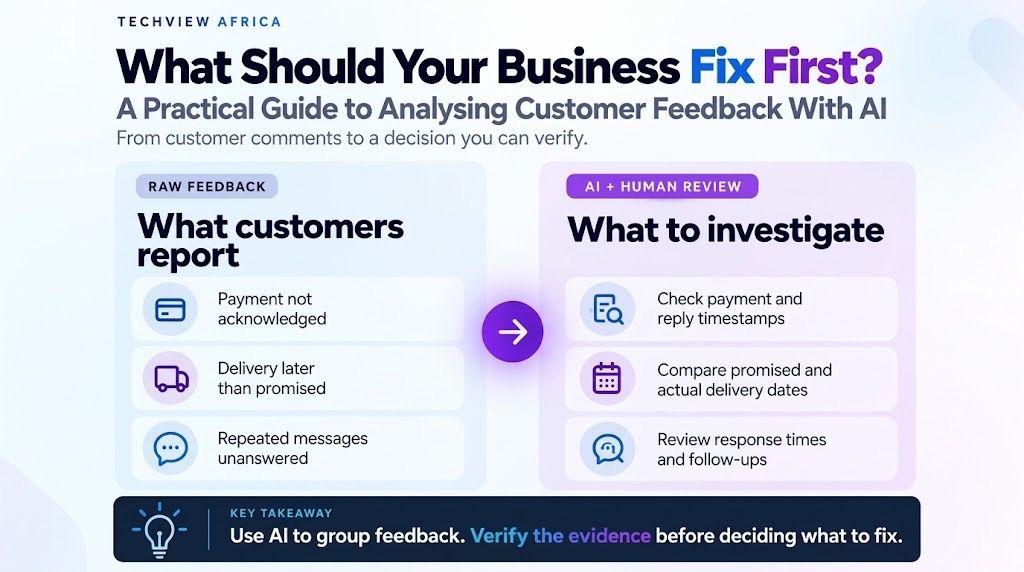
What Should Your Business Fix First? A Practical Guide to Analysing Customer Feedback With AI
From Idea to Clickable Prototype: How to Test a Product With AI Before You Build It

AI Sextortion: What to Do If Someone Threatens You With a Fake Explicit Image

Google Is Giving Nigerian Students Google AI Plus Free for One Year: Here’s How to Claim It
How to Turn Raw Data Into Charts, Insights and a Finished Report With AI
Meta Wants Muse to Help Run Small Businesses. Here’s What Owners Should Keep Under Human Control
Follow TechView Africa on WhatsApp
Get TechView Africa updates on WhatsApp. Follow our channel for practical technology news, product guides and digital trends from Nigeria and across Africa.
Leave a comment
Comments cannot be edited or deleted after posting. Please review your comment before submitting.
No comments yet. Start the conversation.