

Google and AWS are lowering some software barriers to using alternative AI chips, but easier programming does not prove better performance or lower costs than NVIDIA. For African developers, hardware availability, migration effort and total operating costs remain critical to choosing the right platform.
The AI chip contest is becoming easier to enter, but not necessarily easier to win
A company can build an AI accelerator with promising technical capabilities and still struggle to attract developers. If running a model requires unfamiliar tools, extensive code changes and hours of hardware-specific debugging, many teams will prefer infrastructure they already understand, and that is one of the barriers Google and Amazon are trying to reduce.
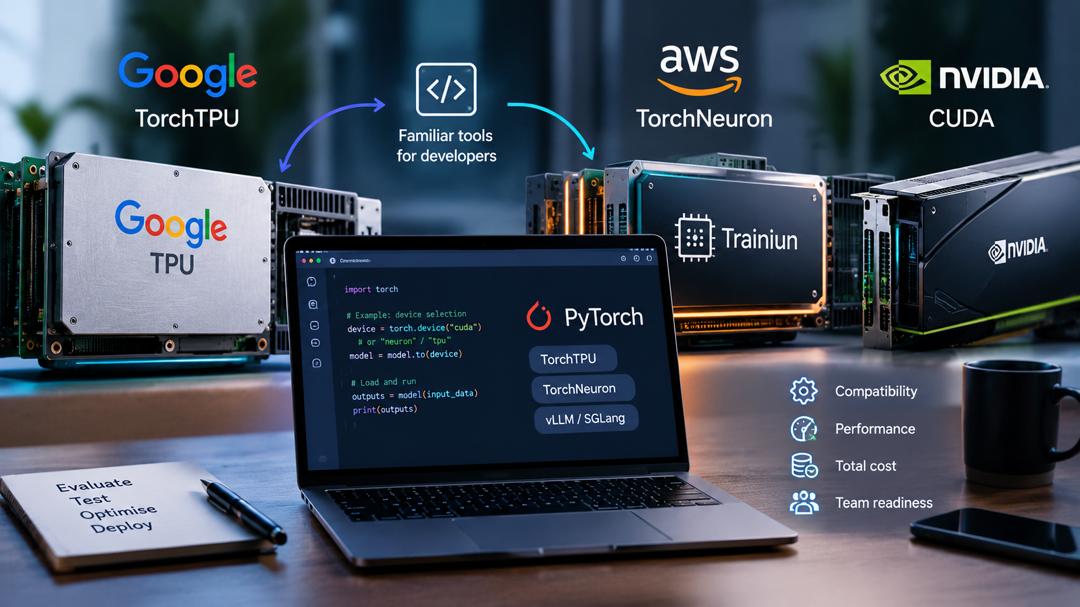
On 20 October 2026, Google announced that TorchTPU, its native PyTorch software stack for Tensor Processing Units (TPUs), was available as open source. It also announced native PyTorch backends for the vLLM and SGLang inference engines. AWS launched the public beta of TorchNeuron, an open-source PyTorch backend for its Trainium2 and Trainium3 accelerators.
These are meaningful software developments, but their significance is more specific than a simple challenge to NVIDIA’s dominance. They make it easier for developers to evaluate competing hardware using familiar programming tools. Whether those alternatives are faster, cheaper or more suitable for production remains a separate question.
The competitive change is therefore best understood as a reduction in the cost of trying alternatives, not proof that NVIDIA has lost its advantage.
What Google and AWS have changed
The two releases address a similar problem through different implementations.
| Platform | What the new software provides | What it does not establish |
|---|---|---|
| Google TPU | TorchTPU brings native PyTorch support, with integrations for inference engines including vLLM and SGLang. | That every model or operation will work unchanged, or that TPUs will be faster or cheaper for a particular workload. |
| AWS Trainium | TorchNeuron supports PyTorch workflows on Trainium2 and Trainium3, including eager execution, torch.compileand standard PyTorch APIs. | That every workload is production-ready or that migration, optimisation and operating costs will be negligible. |
| NVIDIA GPUs | The established CUDA ecosystem, libraries and developer tooling remain important for teams whose workloads already depend on them. | That NVIDIA is automatically the best choice for every model, budget or deployment. |
The practical attraction is that developers can retain more of their existing workflow. AWS, for example, documents a simple device-placement change from .to('cuda') to .to('neuron') for supported eager-mode PyTorch code. Google is building a comparable route for running native PyTorch workloads on TPUs and integrating them with established serving tools.
That does not make the hardware interchangeable. Applications may rely on custom CUDA kernels, specialised operators or libraries whose behaviour differs across platforms. Even when a model runs, teams may still need to change its implementation, adjust precision settings or tune execution to obtain acceptable performance.
A familiar programming interface reduces some migration friction. It does not eliminate the engineering work associated with a different architecture.
Four tests determine whether an alternative is genuinely viable
The announcements can be assessed through four practical tests. This framework helps explain what software compatibility solves and what it leaves unresolved.
1. Can the workload run?
The framework and its required operations must be supported. Native PyTorch integration can reduce changes to model code, but developers still need to check compatibility for the specific model, dependencies and execution path.
2. Can it run efficiently in production?
A successful test run is not evidence of competitive performance. Teams need to measure throughput, time to first token, latency under realistic demand, memory consumption and reliability. Inference workloads can behave differently from training workloads, so results from one should not be treated as a proxy for the other.
3. Does the economics work?
The relevant figure is not merely the hourly price of an accelerator. Teams need to compare the total cost of producing the same useful output, including utilisation, networking, storage, data transfer and engineering time. A cheaper instance can be a poor value if it needs more hardware or substantial optimisation to meet the same service requirements.
4. Can the team access and operate it?
Hardware availability, regional capacity, account eligibility, latency and data requirements can influence the decision as much as software support. This test is particularly relevant to businesses deploying services for African users.
Google and AWS are directly addressing parts of the first two tests. Their releases do not settle the other questions for every workload. That is why easier access to alternative hardware should not be confused with evidence that it delivers a better commercial outcome.
What this means for NVIDIA
NVIDIA’s competitive position cannot be assessed by comparing programming interfaces alone. Its software ecosystem is part of the value proposition: teams may have existing code, debugging expertise, deployment processes and libraries built around CUDA. The effort required to replace those dependencies can make an alternative less attractive even when the chip itself looks promising.
Google and AWS are working to reduce that barrier. Familiar PyTorch APIs and established inference tools can make it easier to test another platform without rebuilding an entire software stack from the ground up.
That gives developers more room to compare options and gives rival chipmakers a clearer route into workloads that might otherwise remain on NVIDIA hardware.
But the releases do not prove that NVIDIA’s overall advantage is narrowing across performance, cost, availability or ecosystem maturity. Establishing that would require comparable results from real workloads, along with evidence about adoption and the effort involved in moving production systems.
For a broader view of how control of developer platforms influences competition, see TechView Africa’s earlier analysis, NVIDIA’s Hugging Face deal and the future of open AI. Software distribution and hardware choice are increasingly connected, but they remain distinct parts of the competitive picture.
The African constraint: software support is not the same as hardware access
For Nigerian and other African developers, there is another question: where can the new hardware actually be rented?
AWS’s published EC2 regional inventory lists G4dn and Inf1 among the accelerated-computing instance families available in Cape Town. It does not list Trainium2 or Trainium3 instances in that region. That is a concrete limitation for teams hoping to use Trainium close to African users: the availability of TorchNeuron does not mean the accelerator itself is available in every AWS region.
Developers may still be able to access Trainium through supported overseas regions, subject to capacity and account eligibility. However, using infrastructure farther away can introduce additional considerations, including network latency, data-transfer costs and the handling of sensitive data. Google TPU availability also depends on the specific hardware and supported zone, so teams should check the relevant location and capacity information before designing a deployment around it.
This is not just a question of which chip has the strongest specifications. It is a question of which chip a team can access reliably, operate economically and use in a way that meets its service and data requirements.
TechView Africa has previously examined the physical side of that challenge in what a proposed 174MW Cape Town data-centre development reveals about Africa’s AI infrastructure needs. Better software can widen the choices available to developers, but it cannot by itself create local accelerator capacity.
What developers should do next
Teams considering Google TPUs or AWS Trainium should begin with the model and workload they actually intend to deploy. They should verify compatibility, estimate migration effort, test performance under realistic demand and compare total operating costs for the same useful output.
They should also check where the required accelerator is available and whether the deployment meets their latency, data-residency and reliability requirements. A successful demonstration is a starting point, not a reason to commit a production system.
TechView Africa has not independently benchmarked these platforms for this article. The analysis is based on the published software capabilities and regional inventory, and it does not claim a performance or cost winner. A fair ranking would require reproducible tests on equivalent workloads.
Our Recommendation
Treat TorchTPU and TorchNeuron as reasons to evaluate more than one AI accelerator, not as proof that NVIDIA has lost its lead. The useful comparison is whether a particular platform can run the required workload, meet performance targets, deliver acceptable total cost and remain accessible under the organisation’s operating constraints.
For African teams, regional availability should be part of that decision from the beginning, not an afterthought. Google and AWS are reducing some software barriers; whether that translates into a better choice depends on the workload and the infrastructure available to the developer.
Sources & Verification
Google Cloud: TorchTPU is now open source
Frequently asked questions
Does native PyTorch support mean developers can move away from NVIDIA without rewriting code?
Not necessarily. It can reduce the changes required, but custom CUDA kernels, unsupported operations and hardware-specific optimisations may still require substantial work. Teams need to check their own dependencies.
Are Google TPUs or AWS Trainium now cheaper than NVIDIA GPUs?
The software announcements do not establish that. A proper comparison must measure the cost of running the same workload to the same service requirements, including hardware utilisation and the engineering needed to optimise it.
Can African developers use AWS Trainium locally?
AWS’s published regional inventory does not currently list Trainium2 or Trainium3 instances in Cape Town. Access through another supported AWS region may still be possible, but developers should verify current regional availability and capacity before planning a deployment.

MORENA AI Supports 12 African Languages, but How Accurate Is It?

We Analysed Software Engineering Jobs in Africa: These 7 Skills Still Matter Even When AI Can Write the Code

How to Turn Raw Data Into Charts, Insights and a Finished Report With AI

50 Remote AI Jobs and Expert Projects Open Across Micro1, Mercor, Outlier and Handshake AI
How to Apply for Nigeria’s National AI Innovation Challenge 2026

We Checked 20 Humanoid Robot Deployments. Only Two Published Quantified Operating Results
We Analysed AI Job Listings Across Africa: Here’s What We Found
Follow TechView Africa on WhatsApp
Get TechView Africa updates on WhatsApp. Follow our channel for practical technology news, product guides and digital trends from Nigeria and across Africa.
Leave a comment
Comments cannot be edited or deleted after posting. Please review your comment before submitting.
No comments yet. Start the conversation.