


A Nigeria–Benin customs data-exchange pilot began in September, but October assessments found obstacles to wider deployment. Faster electronic declarations will not eliminate unreliable power, faulty equipment or national clearance requirements.
Nigeria, Benin and Cameroon Plan Digital Customs Integration, but Border Challenges Remain
Nigeria, Benin and Cameroon plan to connect their customs databases so that information submitted in one country can help prepare import documents in another. The ambition is substantial. Benin Customs wants to reduce the time goods spend at the Sèmè–Kraké border from an estimated 12–36 hours to less than three hours.
But official announcements reviewed by TechView Africa reveal a gap between the pilot's targets and the infrastructure available to deliver them. Two border crossings still face electricity, connectivity, equipment and coordination problems.
How Would Customs Data Move Between the Countries?
The proposed Customs Declarations Exchange System (CDES) would share information among Nigeria's B'Odogwu, Benin's Customs Webb and Cameroon's CAMCIS platforms, according to the Nigeria Customs Service's October statement.
A Nigerian export declaration, for example, could help pre-fill an import manifest in Benin. Beninese customs would still verify the information, apply national rules, assess risks and decide whether goods can be released.
Proposed workflow - Nigeria to Benin (illustrative):
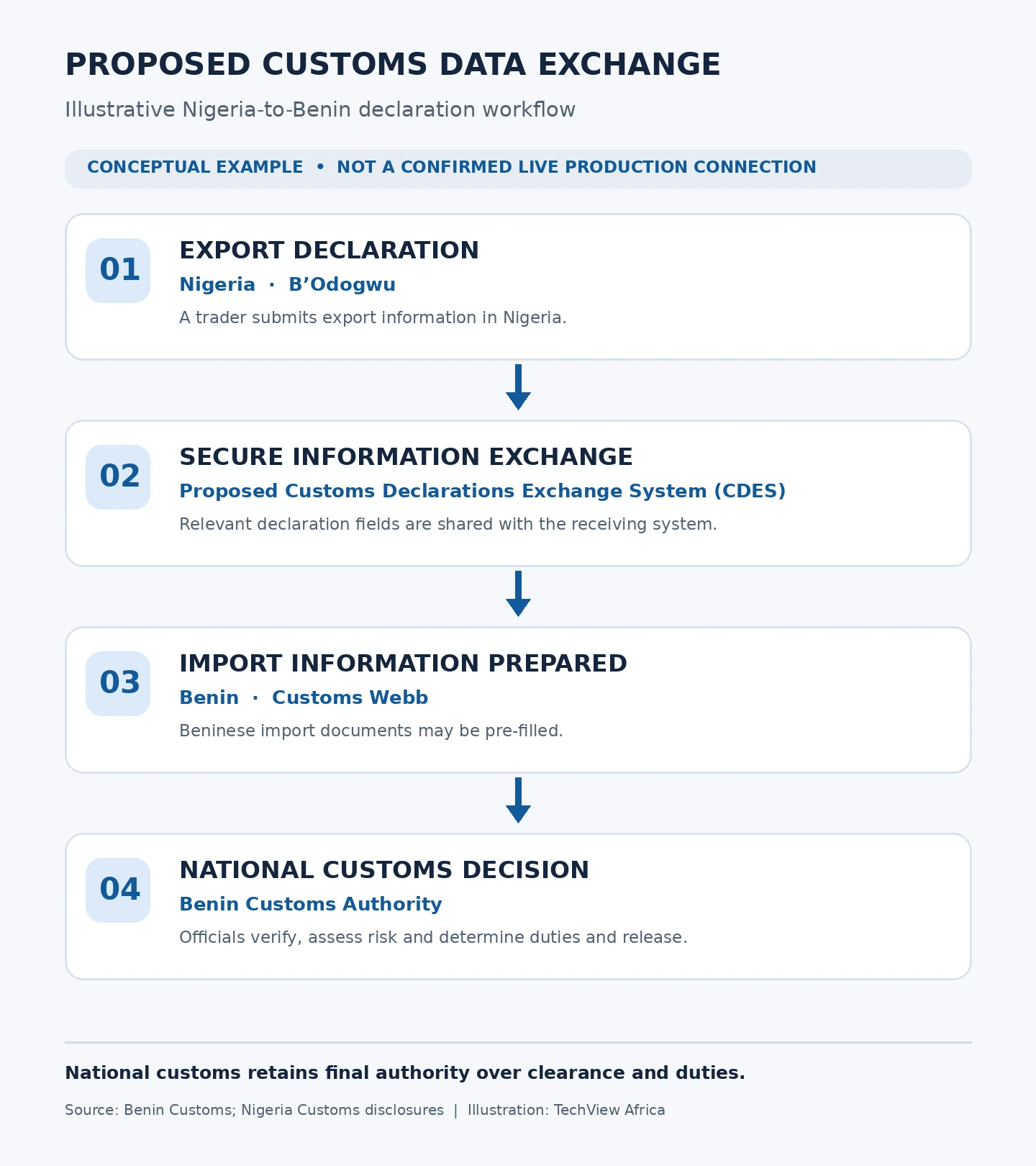
Illustration: TechView Africa. This describes the proposed information flow, not a confirmed live production connection or the full three-country architecture.
Development and testing have been reported, but additional API integration, country-specific configuration, security checks and formal pilot acceptance are still required. No new trader-facing CDES registration procedure has been announced; businesses should follow existing customs instructions until their authorities publish changes.
The September Pilot Set a Measurable Target
Benin Customs announced a CDES pilot at Sèmè-Kraké on 11 September 2026, targeting a reduction in goods' time at the border from 12–36 hours to under three hours, and advance processing of more than 80% of declarations.
Meeting the target would mean saving more than nine hours at the lower baseline, and more than 33 hours at the upper baseline. This is an illustrative calculation, not a measured result.
Importantly, Benin Customs describes the figure as time goods spend at the border. It is not merely a target for filling in electronic forms, nor a guarantee that every truck will cross in three hours. No comparable results dataset establishing that the goal has been achieved was found in the reviewed disclosures.
The effort also predates CDES. In May 2025, ECOWAS announced the launch of SIGMAT deployment between Nigeria and Benin. SIGMAT exchanges information about goods in transit; CDES focuses on sharing customs declarations to prepare import information. The initiatives are related but not interchangeable.
What Is Preventing Faster Border Crossings?
The October assessment identified different deficiencies at two crossings:
| Sèmè–Kraké: Nigeria–Benin | Mfum–Ekok: Nigeria–Cameroon |
|---|---|
| Unreliable power; limited live data exchange | Unreliable power and connectivity |
| Non-functional scanners and weighing facilities | Scanners not yet fully commissioned; inadequate IT equipment |
| Traffic congestion, inconsistent operating hours and unclear maintenance responsibilities | Cybersecurity and technical-support gaps; weak coordination of one-stop processing |
These documented deficiencies explain why sharing a declaration cannot, by itself, clear a physical queue or restore a cargo scanner.
Successful integration also requires consistent data definitions, authenticated access, reliable error handling and an agreed process for correcting inaccurate declarations. The World Customs Organization Data Model provides a reference for harmonising trade information, but the reviewed CDES announcements do not specify whether, or how, it is being adopted.
Responsibility for correcting mistakes and handling outages remains an unanswered operational question. A receiving customs authority retains its legal clearance powers, but public disclosures do not yet describe a complete cross-border correction and incident-response procedure.
Will Traders Pay Less or Change How They Work?
Customs duties will not automatically fall. Sharing data may cut repeated entry, administrative delays and associated business costs, but tariffs, taxes and required inspections remain governed by each country's rules. Neither a tariff reduction nor a new public CDES application has been announced as part of these talks.
For exporters and importers, the potential gain is more predictable document handling. That could particularly benefit smaller traders who struggle to absorb delays. Yet businesses should not calculate savings using the three-hour target until border-wide performance is measured.
The distinction resembles Africa's cross-border payment interoperability efforts: connecting infrastructure does not automatically remove the legal and operational steps around each transaction.
When Will the Three-Country System Be Ready?
No confirmed date has been announced. During talks on 12 October 2026 in Cairo, Nigeria Customs, its neighbours and Afreximbank discussed a two-stage process: independent engineering and cost assessments, followed by separate financing and implementation proposals for the Nigeria–Benin and Nigeria–Cameroon corridors.
There is still no announced final cost, lending commitment or implementation contract. A bilateral pilot launch, technical testing, acceptance and full three-country operation are separate milestones.
The decisive evidence will be actual exchanged declarations, functioning border equipment, published clearance-time measurements and clear procedures for disputes and system failures.
Until then, the most important question is not whether the databases can connect, but whether traders are genuinely spending less time at the border.
Sources & Verification
Benin Directorate-General of Customs — September 2026 CDES pilot and processing targets
ECOWAS — May 2025 SIGMAT launch between Benin and Nigeria
Nigeria Customs statement reproduced by PRNigeria — October 2026 border modernisation discussions
World Customs Organization — Data Model for cross-border interoperability
Frequently asked questions
1. What is the Customs Declarations Exchange System (CDES)?
The Customs Declarations Exchange System (CDES) is a proposed digital arrangement that would allow customs authorities in Nigeria, Benin and Cameroon to exchange trade declaration information electronically. It aims to reduce repeated paperwork, support advance processing of import documents and improve coordination between national customs systems.
2. Is the customs data exchange system already operational in Nigeria, Benin and Cameroon?
Not fully. Nigeria and Benin announced a CDES pilot at the Sèmè–Kraké border in September 2026, but the broader three-country integration remains incomplete. Technical configuration, cybersecurity assessments, infrastructure improvements and formal acceptance procedures are still required before full implementation.
3. Will the new customs system reduce import duties and clearance costs?
CDES does not automatically reduce import duties, VAT or other legally required charges. However, exchanging declaration information electronically could reduce administrative expenses, repeated data entry and delays. Any actual savings will depend on how effectively the system operates at individual border crossings.
4. When will the Nigeria–Benin–Cameroon customs integration be completed?
As of 20 October 2026, no confirmed completion date has been announced. The participating authorities and Afreximbank are still considering engineering assessments, financing arrangements and implementation requirements. The existing Nigeria–Benin pilot should not be confused with full operational integration across all three countries.
5. Will Nigerian importers and exporters need to register on a new customs platform?
No new public registration process specifically for CDES has been announced. The proposed arrangement is intended to connect existing customs systems, including Nigeria's B'Odogwu, Benin's Customs Webb and Cameroon's CAMCIS. Traders should continue following current customs declaration procedures until the relevant authorities issue official instructions.

WhatsApp Business Platform Charges Are Live: What Nigerian SMEs Need to Check Now

NDPC Registration in Nigeria: Does Your Business Need to Register?
CBN’s January 2027 Data Rule: What Nigeria’s Banks and Fintechs Actually Have to Move

Why African Startups Struggle to Win Their First Enterprise Customer Even After Building a Good Product
Lagos Life’s Virtual Billboards: Can a Nigerian Browser Game Build a Sustainable Business?
Nigeria Wants Banks and Telcos to Ask Before Checking Your NIN

How to Apply for Builders Festival ’26: Build Your Case Around One Institutional Problem
Follow TechView Africa on WhatsApp
Get TechView Africa updates on WhatsApp. Follow our channel for practical technology news, product guides and digital trends from Nigeria and across Africa.
Leave a comment
Comments cannot be edited or deleted after posting. Please review your comment before submitting.
No comments yet. Start the conversation.