

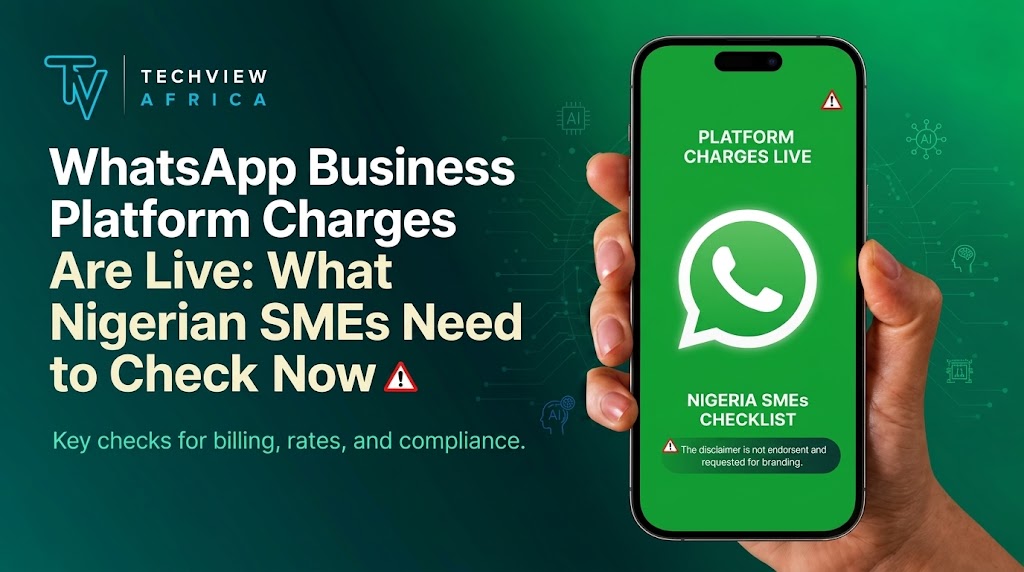
Do not assume that running a business on WhatsApp now means paying for every message. The important question is whether your business uses the WhatsApp Business Platform/API and how many chargeable outbound messages it delivers.
WhatsApp Business Charges Are Now Live: What Nigerian SMEs Should Check
From 1 October 2026, businesses using the WhatsApp Business Platform can be charged for service replies that were previously free. The first 1,000 delivered service messages per business phone number each month remain free; the change does not apply to ordinary WhatsApp or the standard WhatsApp Business mobile app.
For many Nigerian businesses, WhatsApp is more than a messaging app. It is where customers ask whether an item is available, confirm payments, track deliveries, book services and complain when something goes wrong.
From 1 October 2026, the economics of handling some of those conversations changed. Meta now charges businesses using the WhatsApp Business Platform for service messages after a monthly free allowance, while utility messages sent during the 24-hour customer-service window also become chargeable. The change follows the pricing update TechView Africa examined before implementation in our earlier report on WhatsApp customer-service messaging charges. But the most important distinction remains the same: this is not a charge on every Nigerian business using WhatsApp.
WhatsApp Business app or Business Platform? Check this first
A small retailer who installs the free WhatsApp Business app on a phone and manually replies to customers is not suddenly paying Meta for each ordinary chat.
The new billing rules concern the WhatsApp Business Platform, sometimes still called the WhatsApp Business API. It is the infrastructure businesses connect to customer-support software, CRMs, chatbots, e-commerce systems and other tools for messaging customers at scale.
Meta describes the WhatsApp Business Platform as its API-based business messaging system. That distinction matters because “WhatsApp Business” can refer casually to both products even though their billing models are different. If your company simply uses the WhatsApp Business mobile app, this particular API pricing change is not the bill you need to worry about.
What changed on 1 October?
When a customer messages a business through the Platform, a 24-hour customer-service window opens or resets. Businesses can use non-template service messages during that period for example, an agent answering a question about an order or a bot responding to a support request. Those service messages had been free since November 2024.
From 1 October, Meta charges for delivered service messages after the first 1,000 service messages per business phone number each month. The allowance resets monthly and unused messages do not roll over. Utility templates sent during the same customer-service window have also become chargeable and do not receive that 1,000-message service allowance.
The 24-hour window itself has not disappeared. It still determines when a business can send ordinary free-form service replies; it simply no longer guarantees that those replies are free.
What does WhatsApp cost in Nigeria now?
This is where Nigerian businesses should be careful with headlines. Some reports published around the change quoted approximately $0.0101, often converted to about ₦14, for a Nigerian service or utility message. However, current October rate-card mirrors used by WhatsApp Business Platform providers list Nigeria at $0.0067 per delivered utility/authentication message, with service messages charged at the same market rate once the free allowance is exhausted. They list the Nigerian marketing-message rate at $0.0516.
Meta's official WhatsApp Business Platform pricing page confirms that charges depend on the recipient's market and message category and are based on messages that are delivered. For that reason, Nigerian businesses should not build a budget around a fixed ₦14 headline. Check the current Meta rate applicable to your account and the charges imposed by your Business Solution Provider.
Using the current $0.0067 Nigerian service rate as a planning illustration:
| Delivered service messages in a month | Free allowance | Approx. billable messages | Meta service-message cost |
|---|---|---|---|
| 1,000 | 1,000 | 0 | $0 |
| 10,000 | 1,000 | 9,000 | $60.30 |
| 100,000 | 1,000 | 99,000 | $663.30 |
| 500,000 | 1,000 | 499,000 | $3,343.30 |
These figures cover the Meta service-message charge only. Your CRM, chatbot company or WhatsApp Business Solution Provider may have separate subscription, platform or per-message fees.
Exchange rates also move, so converting the dollar rate into a permanent naira figure can quickly become misleading.
One long customer conversation can now matter
Per-message billing makes the design of automated conversations more important.
Consider a support bot that sends:
“Hello.”
“Your payment has been found.”
“It is currently processing.”
“Please allow a few minutes.”
“Would you like help with anything else?”
That is five outbound messages where one or two well-written responses might have delivered the same information.
Businesses do not need to make customer support frustrating simply to reduce costs. But unnecessary message fragmentation now has a measurable price. This is particularly relevant for ecommerce businesses, fintechs, logistics companies and customer-support operations whose bots may handle thousands of conversations.
Businesses adding more AI to these workflows should also keep cost optimisation separate from decision control. TechView Africa's examination of Meta Muse and small-business AI automation explains why customer communications, payments and consequential actions still benefit from human oversight.
Some WhatsApp Business Platform messaging can still be free
The new rules do not mean every business message attracts a Meta charge. Incoming customer messages do not carry the outbound service-message charge. Each business phone number also receives its 1,000 free delivered service messages each month.
Meta additionally maintains a free-entry-point mechanism for qualifying conversations that begin through a Click-to-WhatsApp advertisement or a Facebook Page call-to-action button. Its official pricing information says qualifying messages during the following 72 hours are not charged. Businesses should therefore examine their actual messaging flow rather than multiplying every WhatsApp interaction by one headline rate.
What Nigerian SMEs should check now
First, establish whether you actually use the WhatsApp Business Platform or only the standard Business app. If you use the Platform, check how many outbound delivered service messages each business phone number sends monthly. A company comfortably below 1,000 may pay nothing for that service-message category, while a high-volume support operation could see a meaningful new bill.
Next, separate service, utility, authentication and marketing messages. They do not all have the same pricing treatment. Then check your provider's own fees. Meta's charge may be only one component of the amount appearing on your invoice.
Finally, review automated conversations for unnecessary replies. Combine information where doing so improves clarity, use structured options where appropriate and avoid making a bot send three messages when one complete response would work better. The aim should be better conversation design, not poorer customer service.
Our Recommendation
Nigerian SMEs should first confirm whether they use the WhatsApp Business Platform before changing anything. Most businesses operating only through the standard WhatsApp Business mobile app should not interpret the October update as a new per-chat fee.
Businesses using the Platform should measure their real message volume, verify the current Nigerian rate in their Meta or provider billing environment, check third-party fees and review automated conversations that generate unnecessary outbound messages.
Most importantly, do not rely on a fixed Naira figure circulating in headlines. WhatsApp pricing is market- and category-specific, provider fees differ, and currency conversions change.
Sources & Verification
WhatsApp Business — Official Business Platform Pricing
WhatsApp Business — Business Platform Overview
TechView Africa — Earlier Report on the October WhatsApp Pricing Change
Kapso — WhatsApp Pricing by Country, Effective October 2026
Techpoint Africa — WhatsApp Business Platform Billing Explainer
Frequently asked questions
Does WhatsApp now charge every Nigerian business per message?
No. The new service-message charges concern businesses using the WhatsApp Business Platform/API. They should not be confused with ordinary WhatsApp or the standard WhatsApp Business mobile app.
How many WhatsApp service messages are free?
Each business phone number receives a monthly allowance of 1,000 delivered service messages. The allowance resets each month and unused messages do not roll over.
Does the 1,000-message allowance cover utility messages?
No. The allowance applies to service messages. Utility templates sent during the customer-service window became chargeable from 1 October.
Is the WhatsApp Business charge ₦14 per message in Nigeria?
Businesses should not treat ₦14 as a fixed official price. Some reports used that approximation, but current October rate-card mirrors list Nigeria's utility/authentication rate at $0.0067, with service messages priced at the same market rate. Naira equivalents also change with exchange rates, so businesses should confirm the current rate in their own billing environment.
Can a business still use WhatsApp for customer support cheaply?
Yes, particularly at lower volumes. The first 1,000 delivered service messages per business phone number each month are free, while efficient conversation design can reduce unnecessary chargeable replies.
Lagos Court Draws a Line Between Contact Access and Consent in Truecaller Case
CBN’s January 2027 Data Rule: What Nigeria’s Banks and Fintechs Actually Have to Move

Seven Free AI Tools That Are Actually Useful on a Smartphone
WhatsApp to Start Charging Businesses for Customer-Service Replies From October 1
Nigeria Wants Banks and Telcos to Ask Before Checking Your NIN
How to Apply for Builders Festival ’26: Build Your Case Around One Institutional Problem

Nigeria at 66: Six Numbers That Explain How Digital the Country Has Become
Follow TechView Africa on WhatsApp
Get TechView Africa updates on WhatsApp. Follow our channel for practical technology news, product guides and digital trends from Nigeria and across Africa.
Leave a comment
Comments cannot be edited or deleted after posting. Please review your comment before submitting.
No comments yet. Start the conversation.