


Do not stop learning to code because AI can code. Learn enough engineering to design the system, inspect what AI produces, find failures, secure it and operate it reliably in production.
These 7 Skills Still Matter Even When AI Can Write the Code
AI can generate code, propose software architectures and help developers fix errors. But examining engineering vacancies at African technology companies reveals a more important requirement: employers still need people who understand how software works, why systems fail and whether AI-generated code is safe to deploy.
How TechView Africa conducted this analysis: We independently examined four employer-published engineering vacancies from Yassir and Moniepoint, two African technology companies, to understand which technical competencies remain valuable as AI increasingly assists with software development. Our review compared the roles' stated responsibilities and requirements across programming, system architecture, debugging, software testing, distributed systems, cloud infrastructure, security and AI-assisted development. From these comparisons, we identified seven essential engineering skill areas that illustrate how employers continue to prioritise technical judgement, reliability and the ability to build and maintain production-ready systems beyond simply writing code.What the employer vacancies actually show
Our comparison identifies the responsibilities emphasised in four published engineering positions.
| Employer and position | Requirements highlighted | Main skills illustrated |
|---|---|---|
| Yassir — Lead Engineer, Algeria | Architecture, distributed systems, AI-assisted development, code review, documentation and security | System design, scalability, AI supervision and communication |
| Moniepoint — Principal Generalist Engineer | Production systems, debugging, reliability, distributed systems and infrastructure | Engineering fundamentals, debugging, architecture and operations |
| Moniepoint — Lead, Test Automation & Tools | Automated testing frameworks, performance testing and security testing | Software testing, quality assurance and security |
| Moniepoint — Senior Frontend Engineer | JavaScript, TypeScript, React, frontend architecture, performance and code review | Programming fundamentals, architecture, performance and maintainability |
TechView Africa's finding: These vacancies do not treat writing code as the entire engineering profession. They place substantial responsibility on people who can make technical decisions, verify results and maintain systems after deployment.
The sample is small and deliberately selected to illustrate explicit employer requirements. It should not be interpreted as a ranking of the most frequently requested software skills across Africa.
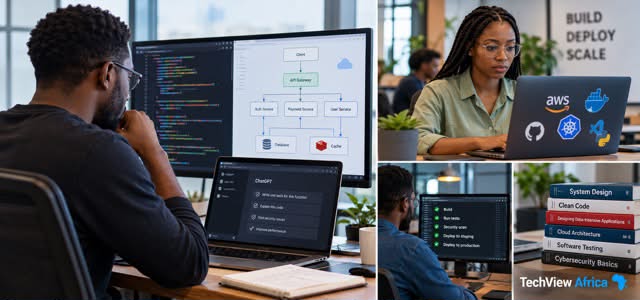
1. Programming fundamentals still matter
AI can generate Python, JavaScript and other programming languages, but developers still need enough technical understanding to determine whether the generated code is correct.
Moniepoint's Senior Frontend Engineer listing, for example, requires JavaScript, TypeScript and React expertise alongside responsibility for reliable implementation and maintainability.
For African developers, this means learning a language properly remains valuable. Understand data structures, APIs, databases, asynchronous programming, error handling and how application components interact. The competitive advantage is not typing code faster. It is understanding what the code does.
2. System design and architecture
System design is the ability to determine how a software product should be structured before individual features are implemented.
Yassir's Lead Engineer vacancy places responsibility for software architecture, scalability and technical specifications on the engineer, even where AI agents are expected to generate significant amounts of code.
Moniepoint's Principal Generalist Engineer role similarly emphasises designing systems that can operate reliably in production.
Developers should therefore understand how services communicate, how data flows through applications and how design decisions affect performance, cost and security. AI can propose an architecture, but experienced engineers must evaluate whether it actually fits the problem.
3. Debugging, testing and code review
Generating code is only one part of building software. Testing what happens when that code fails is just as important.
Moniepoint's Lead, Test Automation & Tools position illustrates this requirement through automated testing frameworks, performance testing and security testing.
Yassir also emphasises rigorous code reviews and quality controls for work produced by both human developers and AI agents.
For developers, practical skills include writing tests, interpreting error logs, identifying root causes and reviewing code for security and maintainability.
A project that works during a short demonstration is not necessarily ready for real users.
Our guide to building a working app with AI without knowing how to code explains why testing authentication, permissions and unexpected user behaviour matters.
4. Distributed systems and scalability
Software operating at significant scale has problems that a small personal project may never encounter.
These include slow networks, unavailable services, database bottlenecks, failed background jobs and unexpectedly high traffic.
Yassir explicitly asks for distributed-systems knowledge, concurrency and performance optimisation. Moniepoint's generalist engineering role similarly covers reliable and scalable production systems.
Developers should understand caching, queues, databases, retries, service communication and failure recovery.
For financial technology companies operating across African markets, these skills are especially relevant because payment and business systems must remain dependable under demanding operating conditions.
5. Cloud infrastructure and delivery pipelines
Cloud engineering is not simply knowing how to create an account with AWS, Microsoft Azure or Google Cloud.
It involves understanding how applications are deployed, monitored, secured and recovered when something goes wrong.
Yassir identifies Google Cloud Platform as part of its technology stack, while Moniepoint's engineering requirements extend into infrastructure, observability and reliable deployment.
Developers can strengthen their skills by learning containerisation, CI/CD pipelines, cloud networking, database management and application monitoring. The objective is to understand how software reaches users and continues working after it leaves a developer's laptop.
6. Security engineering
Security is increasingly inseparable from everyday software development. Yassir places security alongside reliability, performance and maintainability in its engineering quality requirements. Moniepoint's test-automation role also addresses security testing.
Developers should understand authentication, authorisation, secrets management, dependency vulnerabilities and how to review AI-generated changes before deploying them.
This matters especially in banking, payments and other services that handle sensitive customer information.
A successful AI-generated feature can still be a serious engineering failure if it exposes private information or allows users to access records they should not see.
7. AI-assisted engineering and technical communication
One of the clearest findings comes from Yassir's Lead Engineer vacancy. The company describes an AI-first development approach in which engineers define precise technical tasks, direct AI agents and validate the resulting work.
This changes the developer's responsibility. Instead of merely requesting code, an engineer must explain the requirements, identify constraints, assess proposed solutions and document decisions. Technical communication, therefore, becomes part of engineering competence.
Developers should learn to write useful specifications, explain architectural decisions and review AI-generated outputs with the same seriousness as human-written code.
Our related analysis of AI job listings across Africa examines how employers are seeking people who can turn AI capabilities into reliable products and business systems.
What these findings mean for African developers
The four vacancies illustrate an important distinction: AI can help produce software, but engineering responsibility extends far beyond producing code.
There are two practical paths.
For beginners, the priority should be building strong programming foundations, learning databases and APIs, understanding version control, and developing confidence in debugging and testing.
For experienced developers, the opportunity is to deepen expertise in system architecture, infrastructure, distributed systems, security and AI-assisted technical leadership.
These findings do not mean every employer prioritises the same skills. They show how selected African technology employers describe the responsibilities that remain essential in their engineering teams.
For more career context, see our analysis of how AI is changing entry-level technology jobs and the skills becoming more valuable.
Our Recommendation
Do not abandon programming because AI can write code. Instead, use AI tools to accelerate development while investing more effort in the skills that let you judge the quality of the result.
If you are starting your software-engineering career, prioritise one programming language, databases, APIs, testing and practical projects before moving into more advanced infrastructure.
If you already have engineering experience, focus on system design, reliability, security, technical leadership and the ability to supervise AI-generated work.
The most valuable engineer is not necessarily the person who produces the most lines of code. It is the person who knows what should be built, why it should work, how it might fail and whether it is safe to release.
The source listings were reviewed on 16 October 2026.
Sources & Verification
Yassir — Lead Engineer, Algeria
Moniepoint — Principal Generalist Engineer
Frequently asked questions
1. Did TechView Africa analyse every software engineering job in Africa?
No. Our research examined four publicly advertised engineering positions from Yassir and Moniepoint. We independently compared their technical requirements and grouped the findings into seven engineering competencies. The results illustrate what these employers value rather than representing a statistical survey of the entire African software engineering market.
2. Are all the engineering positions mentioned open to Nigerian applicants?
Not necessarily. Some positions are advertised internationally or have specific location requirements. We included them to examine the engineering skills sought by African technology companies, not to establish that every vacancy accepts applications from Nigeria.
3. Will AI replace software engineers in Africa?
AI is changing how software is developed, particularly by automating parts of coding, debugging and documentation. However, the vacancies examined by TechView Africa continue to emphasise human responsibilities such as system architecture, security, testing and technical decision-making. These findings do not establish how many engineering jobs AI will replace.
4. Which software engineering skills should African developers prioritise in 2026?
Developers should build strong programming fundamentals before advancing into system design, debugging, automated testing, cloud infrastructure, distributed systems and cybersecurity. Learning to use AI coding tools effectively is also valuable, especially when combined with the ability to evaluate generated code and maintain reliable production systems.
5. Do African software developers still need to learn programming if AI can write code?
Yes. Understanding programming remains essential for evaluating AI-generated solutions, identifying errors, integrating systems and maintaining secure applications. AI can accelerate development, but developers still need the technical knowledge to determine whether the resulting software works correctly, performs reliably and meets users' requirements.

We Checked 20 Humanoid Robot Deployments. Only Two Published Quantified Operating Results

We Analysed AI Job Listings Across Africa: Here’s What We Found
MORENA AI Supports 12 African Languages, but How Accurate Is It?

Remote AI Jobs for Africans: Where You Can Apply, Pay and Eligibility Rules

African Tech Jobs in 2026: What Over 300 Listings Reveal About Hiring Beyond Coding

AWS, Azure or GCP? We Analysed What 100 African Tech Vacancies Reveal About the Cloud Skills Companies Actually Want

How to Turn Raw Data Into Charts, Insights and a Finished Report With AI
Follow TechView Africa on WhatsApp
Get TechView Africa updates on WhatsApp. Follow our channel for practical technology news, product guides and digital trends from Nigeria and across Africa.
Leave a comment
Comments cannot be edited or deleted after posting. Please review your comment before submitting.
No comments yet. Start the conversation.