

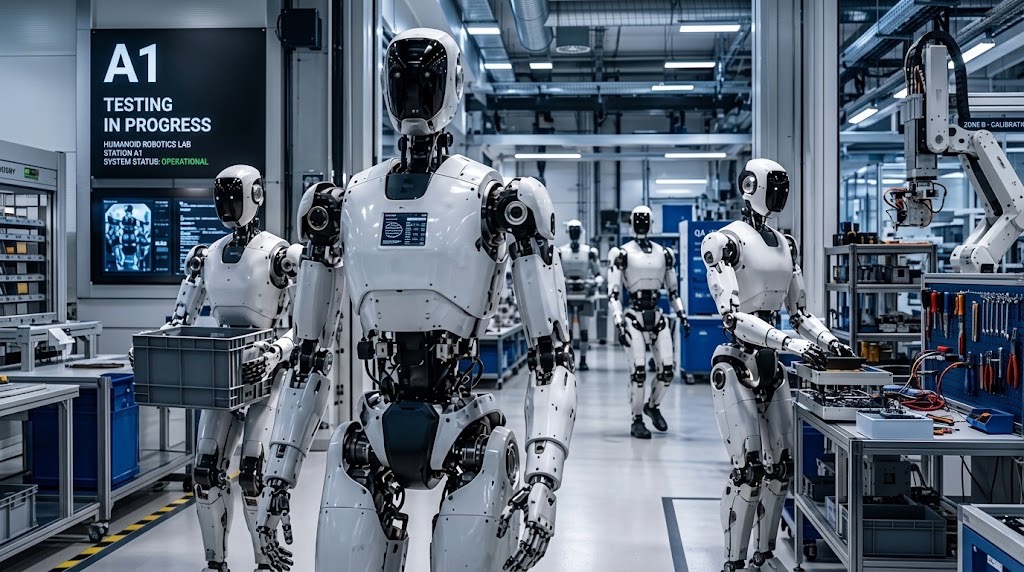
We Reviewed 20 Humanoid Robot Deployments. The Evidence for Sustained Work Is Still Thin
Humanoid robots are already working inside some factories and warehouses, but large-scale productive deployment remains much less common than demonstrations suggest. In TechView Africa's 20-case review, two deployments disclosed quantified operating output, six had evidence of active workplace use without comparable production metrics, and 12 remained pilots, training programmes or proofs of concept.
About 7,000 humanoid robots were sold globally in 2025 for industrial and professional-service applications, according to newly reported data from the International Federation of Robotics. Most, however, were still being used for research, AI training and data collection rather than ordinary productive work.
That creates an important distinction. A humanoid can be sold, demonstrated inside a factory or described as “deployed” without performing a regular production task at meaningful scale.
TechView Africa reviewed 20 prominent, named workplace deployments and pilots disclosed by robot manufacturers, customers, company filings and credible reporting. We found only two cases with publicly disclosed operating records detailed enough to show sustained output over time. Six more involved active workplace deployments but lacked comparable public production data. The remaining 12 were pilots, training programmes or proofs of concept.
The finding does not show that the other robots failed. It shows something narrower but important: the public evidence for humanoid robotics is developing much more slowly than the industry's ambitions.
How we classified the 20 deployments
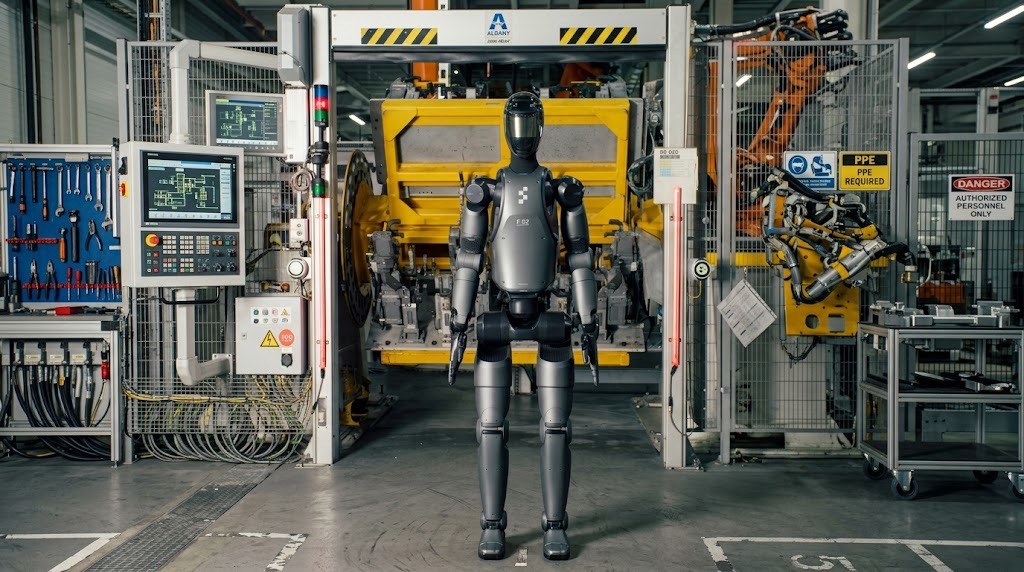
We reviewed named workplace deployments involving Figure, Agility Robotics, Apptronik, UBTECH, Spirit AI and Hexagon Robotics. We excluded home demonstrations, trade-show performances, military applications and vague customer claims where a workplace could not be identified.
Each case was classified according to the strongest publicly available evidence as of 21 September 2026:
| Evidence level | What we required | Cases | Share |
|---|---|---|---|
| Quantified operating record | Live workplace task plus disclosed output or operating-duration data | 2 | 10% |
| Active workplace deployment | Robot physically operating at a named workplace, but without comparable public output data | 6 | 30% |
| Pilot / training / proof of concept | Testing, task training, data collection or limited evaluation | 12 | 60% |
We counted customer-site programmes rather than individual robots. The sample is not a census of every humanoid deployment worldwide, and manufacturers disclose very different amounts of information. Absence of published metrics therefore does not prove poor performance. It does, however, tell us how much evidence is currently available to outsiders trying to distinguish commercial operation from experimentation.
BMW and GXO provide unusually strong evidence
The clearest case is Figure's deployment at BMW's Spartanburg plant in the United States. BMW says Figure 02 worked 10-hour shifts, five days a week, moving more than 90,000 sheet-metal components during roughly 1,250 operating hours. Its work contributed to production of more than 30,000 BMW X3 vehicles during the programme. The task itself was much less science fictional than the broader promise of a general purpose robot: Figure 02 retrieved and positioned sheet-metal parts for welding.
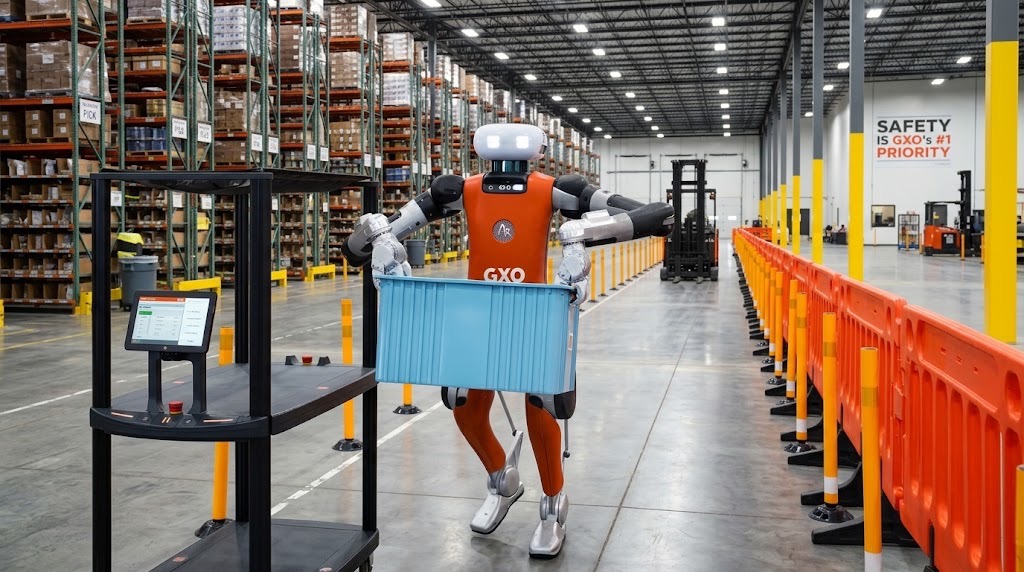
Agility Robotics' Digit provides the other particularly well-documented example. Under a multi-year commercial agreement with GXO, Digit unloads totes from autonomous mobile robots and places them onto conveyors at a logistics facility near Atlanta. Agility says the deployment has passed 100,000 totes moved, while its latest disclosures put Digit's accumulated work across customer sites above 65,000 operating hours.
These cases matter because they measure something more useful than whether a robot can perform a task once: repetition under normal operating conditions.
Most deployments are still narrower than the humanoid narrative
The rest of the sample shows how easily different stages of development can become blurred.
Agility says Digit is now actively deployed with Toyota Motor Manufacturing Canada, Schaeffler and Mercado Libre as well as GXO, but publicly comparable throughput data for those newer deployments are not yet available.
Spirit AI says its Moz robots are performing battery-production tasks at CATL, including high-voltage battery-connector insertion. Reuters separately reported that dozens of Moz robots were working on production lines at CATL and JD.com. That is stronger evidence than a stage demonstration, but the companies have not disclosed operating records comparable with BMW's 90,000-part tally or GXO's 100,000 totes.
At BMW's Leipzig plant, Hexagon's AEON is already performing production tasks while simultaneously being trained for additional manufacturing work. BMW still describes the programme as a pilot.
Apptronik's Apollo has similarly entered real industrial environments. Mercedes-Benz is training and testing Apollo for intralogistics and component-quality tasks, Jabil announced a manufacturing pilot, and GXO described its Apollo programme as an early-stage proof of concept.
UBTECH's own annual reporting provides an even clearer example of the distinction. Walker-series robots have trained at factories belonging to BYD, Geely, Foxconn, Dongfeng Liuzhou Motor, FAW-Volkswagen, Audi FAW and BAIC, as well as logistics company SF. The company describes activities including material handling, charging-gun manipulation and logistics testing, but much of this work was explicitly described as training rather than mature commercial operation.
That accounts for much of the 60% of Techview Africa's sample still classified as pilot, training or proof-of-concept work.
The robots doing useful work are doing surprisingly specific jobs
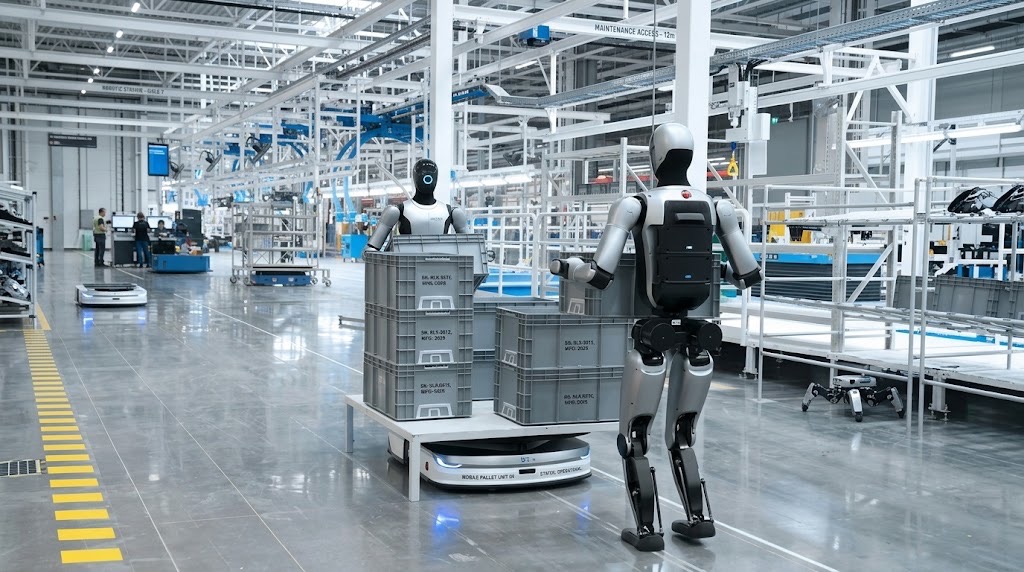
Another pattern emerged from the sample. The strongest deployments are not humanoids replacing an entire employee role. They perform tightly bounded physical tasks:
- loading sheet metal;
- moving totes;
- inserting battery connectors;
- transporting components;
- handling intralogistics;
- inspecting parts.
That matters because the industry's long-term pitch is usually general-purpose physical intelligence: machines able to move between many human tasks with limited reprogramming.
Today's strongest evidence supports something narrower. Humanoids are beginning to prove useful in structured industrial environments, but the commercially convincing work remains highly specific.
Figure's newer Figure 03, for example, returned to BMW in 2026 to demonstrate a more complex sequencing workflow involving picking, positioning and moving carts. It is a technical step beyond Figure 02's earlier task, but Figure itself describes the current work as a demonstration of the new workflow rather than publishing another long-duration production record.
The growth forecasts require an extraordinary change in scale
The 7,000-unit figure also gives the industry's forecasts some perspective. Bank of America Global Research expects humanoid shipments to reach about 90,000 units in 2026 and 1.2 million by 2030, according to Reuters. Reaching the first figure would require shipments to increase by roughly 13 times in one year from the reported 2025 level. Reaching 1.2 million would represent more than 170 times the 2025 volume.
Those are forecasts, not deployments. For additional context, the established robotics industry installed 542,000 conventional industrial robots in 2024, while almost 200,000 professional-service robots were sold that year. IFR itself said in 2025 that massive humanoid use had not yet arrived and that practical applications still needed to be proven.
This does not make the humanoid market insignificant. It shows how far commercial scaling would have to travel to match the narrative surrounding it.
Africa should watch the economics, not just the demonstrations
Africa is beginning to develop its own humanoid capabilities. South Africa opened a manufacturing plant in August for the locally developed IRIS AI Humanoid Tutor, an education-focused robot intended to support teaching and learning. But for African manufacturers considering industrial humanoids, the important comparison will not be human versus robot alone.
A humanoid must compete with conventional industrial robots, autonomous mobile robots, specialised machinery and existing human workflows while also justifying integration, maintenance, energy, safety, technical support and training costs. That makes the employment question more complicated than whether robots can physically perform human tasks. TechView Africa's earlier review of AI job listings across African markets found growing demand for people who can deploy, evaluate and operate AI systems in real organisations. Physical AI would add another layer: robotics integration, maintenance, safety and workflow design.
The same principle appears in our analysis of how AI is changing entry-level technology work. Automation changes tasks before it necessarily eliminates entire occupations. The evidence from humanoids so far points in the same direction.
The useful question is no longer whether humanoid robots can work
They can. BMW and GXO provide credible evidence that humanoids can perform repetitive physical work for extended periods in real industrial environments.
The unresolved question is how often that performance can be reproduced economically, across different tasks and across thousands of machines.
That is the threshold between an impressive robotics industry and the enormous labour transformation described in many humanoid forecasts. For now, public evidence suggests the industry has crossed the first threshold: humanoids can do useful work. It has not yet demonstrated the second at anything close to the scale implied by the forecasts.
Our Recommendation
Treat every humanoid-robot announcement according to its actual deployment stage.
A demonstration shows capability. A pilot tests whether that capability survives a real workplace. A commercial deployment shows someone is willing to pay for it. Quantified operating data shows whether the robot continues doing useful work after the cameras leave.
For African businesses and policymakers, that last category should matter most. Before treating humanoids as an imminent labour-market disruption, look for operating hours, throughput, failure rates, human intervention, total deployment cost and evidence that customers expand beyond the initial pilot.
Verification Links
International Federation of Robotics — World Robotics data and humanoid statistics programme
Reuters — Humanoid robot sales tally reaches about 7,000 in 2025
BMW Group — Figure 02 production results at Plant Spartanburg
Figure — Figure 02 BMW deployment results
Agility Robotics — Digit passes 100,000 totes in GXO deployment
Mercedes-Benz — Apollo humanoid testing in production
GXO — Apptronik Apollo proof-of-concept programme
UBTECH — 2024 annual report documenting factory training programmes
Frequently asked questions
Are humanoid robots already replacing factory workers?
Humanoids are performing real production and logistics tasks, but the publicly documented deployments reviewed by TechView Africa remain small compared with the scale of conventional industrial automation. Most of the 20 cases in our sample were still pilots, training programmes or deployments without detailed public operating metrics.
Does 7,000 humanoid robots sold mean 7,000 robots are working in factories?
No. The IFR figure covers industrial and professional-service humanoid sales, and Reuters reports that many of the robots sold in 2025 were being used for research, AI training and data collection rather than productive work.
Why build a humanoid instead of using a conventional industrial robot?
Human-shaped robots can potentially operate in workplaces, aisles, equipment and workflows originally designed around people. Whether that flexibility is economically better than specialised automation depends on the task, reliability, deployment cost and how frequently the robot can be repurposed.

Should We Slow Down AI? The Human Control Question Behind Autonomous Weapons, AI Agents and Superintelligence

Claude Went From Leading Under 1% of Anthropic’s AI R&D to 26% in Six Months. Here’s What That Means

As AI Agents Gain More Control, Cybersecurity Rules Are Being Rewritten

What a 174MW Cape Town Data Centre Plan Reveals About Africa’s AI Infrastructure Challenge

OpenAI Reported Its AI-Agent ‘Wiki Incident’ to the EU: Here’s What Happened
What Happens After an AI Event Ends? AfricAI Is Building a System to Track It

The Safest Way to Use AI for Research Without Repeating Its Mistakes
Follow TechView Africa on WhatsApp
Get TechView Africa updates on WhatsApp. Follow our channel for practical technology news, product guides and digital trends from Nigeria and across Africa.
Leave a comment
Comments cannot be edited or deleted after posting. Please review your comment before submitting.
No comments yet. Start the conversation.