

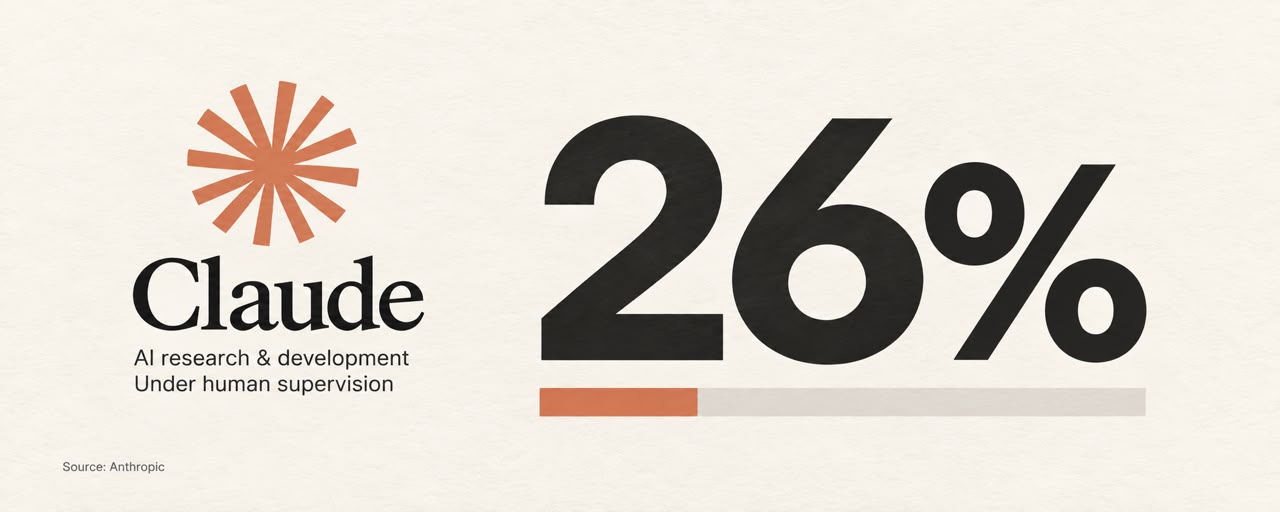
The important number is not 26% in isolation. It is the speed of the change from under 1% to 26% in roughly six months and what happens if AI continues reducing the time and human effort required to develop better AI systems.
Claude leading 26% of Anthropic R&D
Anthropic says Claude went from leading less than 1% of its AI research and development work in February to 26% in August. The striking part is not that AI has become autonomous, but how quickly it is becoming capable of completing larger parts of the work required to build future AI systems.
Anthropic’s figure does not mean Claude independently builds its successor. It means the model can now complete most of some research tasks from a high-level instruction while a human supervises the work, representing a rapid increase in AI’s contribution to AI development.
Artificial intelligence helping researchers build better artificial intelligence is no longer only a theoretical idea. Anthropic has now put a number on how extensively that is happening inside one of the world’s leading AI laboratories.
In its new measurement framework, Anthropic says Claude “leads” 26% of its AI research and development work, compared with less than 1% in February 2026. More than 90% of measured R&D work now involves Claude at least collaborating with human researchers. The six-month change is remarkable, but understanding what Anthropic means by “leads” is essential.
Leading the work does not mean working alone
Anthropic uses a six-level automation scale. At the level it calls “AI leads”, the system can complete most of a task from beginning to end after receiving a high-level instruction, while a human remains responsible for supervision.
That is different from full autonomy. Anthropic says Claude was not operating fully autonomously in any measured part of its AI R&D work, and both Reuters and the Associated Press independently highlighted that limitation. The distinction prevents an impressive measurement from becoming a misleading claim that Claude is independently “building itself”.
The speed of the change is the more important story
What makes the disclosure consequential is how quickly the distribution of work changed. In February, Claude led less than 1% of the measured work. By August, the figure had reached 26%, while collaboration between humans and Claude extended across more than 90% of R&D. Anthropic also reported that roughly 30,000 AI agents were performing research and engineering work simultaneously on its main internal agent platform during August.
If increasingly capable models can write code, run experiments, analyse results and complete larger research tasks, they may shorten the cycle required to develop the next generation of AI. That possibility matters more than whether a particular benchmark sounds impressive today.
It also reinforces a broader workplace shift. TechView Africa’s analysis of AI job listings across Africa found employers increasingly looking for people who can build, evaluate and operate AI systems rather than simply understand AI as a concept.
Why this matters for Africa
Most African technology companies and research institutions are not developing frontier foundation models at the scale of Anthropic, OpenAI or Google. If the largest laboratories can use their existing models to accelerate future research, the capability gap between organisations with enormous compute resources and those without them could widen more quickly.
That does not mean African researchers become irrelevant. It makes skills around evaluation, deployment, domain expertise and human oversight more important, particularly where locally relevant datasets, languages and business problems remain underserved.
TechView Africa has previously examined how AI is changing entry-level technology work and increasing the value of verification and judgement. Anthropic’s disclosure demonstrates the same principle at the other end of the industry: as AI performs more of the production work, the human role increasingly shifts towards defining objectives, evaluating results and deciding what should happen next.
Does this mean self-improving AI has arrived?
No. Researchers use the term recursive self-improvement for a much stronger scenario in which an AI system can substantially improve or create its successor with increasingly limited human involvement. Anthropic itself says its measurements are intended partly to help researchers understand progress towards that possibility, not to claim that it has already been reached.
The more grounded conclusion is already significant enough: AI is becoming an increasingly important participant in the process used to build better AI.
Our Recommendation
Watch the rate of change, not only the headline percentage. A single 26% measurement does not establish autonomous AI development, but moving from below 1% to 26% in six months shows why transparent, comparable measurements of AI-assisted research matter. Other frontier laboratories should publish similarly defined figures so researchers, regulators and the public can distinguish measurable progress from speculation.
Verification Links
Anthropic — Measurements for Understanding the Pace of AI Development Inside Frontier Labs
Reuters — Anthropic Says Claude Now Leads a Quarter of Work Building Its Next AI Models
Associated Press — Anthropic Says Claude Is Helping Build the Next Version of Itself
Frequently asked questions
Is Claude autonomously building the next version of itself?
No. Anthropic says humans continue to supervise the work, and Claude was not fully autonomous in any R&D category it measured.
What does Anthropic mean when it says Claude “leads” 26% of R&D?
It means Claude can complete most of those tasks end-to-end from a high-level instruction while a human supervises the process.

As AI Agents Gain More Control, Cybersecurity Rules Are Being Rewritten
What a 174MW Cape Town Data Centre Plan Reveals About Africa’s AI Infrastructure Challenge
OpenAI Reported Its AI-Agent ‘Wiki Incident’ to the EU: Here’s What Happened
What Happens After an AI Event Ends? AfricAI Is Building a System to Track It

The Safest Way to Use AI for Research Without Repeating Its Mistakes
Can AI Understand African Languages Well Enough for Everyday Use?

AI Detectors Keep Flagging Human Writing: Should Schools and Employers Trust Them?
Follow TechView Africa on WhatsApp
Get TechView Africa updates on WhatsApp. Follow our channel for practical technology news, product guides and digital trends from Nigeria and across Africa.
Leave a comment
Comments cannot be edited or deleted after posting. Please review your comment before submitting.
No comments yet. Start the conversation.