

Key Takeaway: Give an AI agent enough access to prepare useful work, but keep human approval over money, customer communications, permissions, sensitive records and irreversible decisions.
Meta’s Muse Can Help Run a Small Business. The Real Question Is How Much Control to Give It
Muse for Small Business can analyse business information, prepare campaigns, organise tasks and work across connected services. Meta says it still requires approval before anything is published, sent or spent a boundary small businesses should preserve rather than weaken.
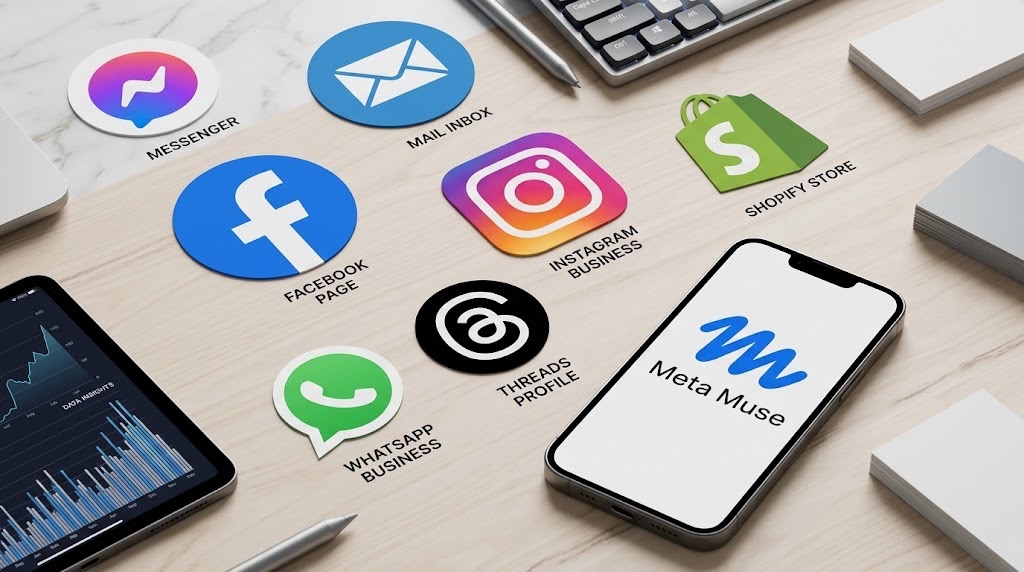
Meta wants its Muse AI agent to move beyond answering questions and into the software that actually runs a small business. Announced on September 29, Muse for Small Business can connect to Facebook Pages, Instagram professional-account analytics and Meta advertising accounts, alongside services including Shopify, Intuit QuickBooks, Stripe, Canva, Slack, Figma, Dropbox, Notion and Zoom. Meta says the agent can then work with information about a company’s storefront, finances, brand and customer records.
The promise is straightforward: instead of opening several applications to analyse sales, review advertising results, prepare content and organise work, an owner could give Muse a broader objective and let the agent coordinate parts of the process.
But Meta has also built an important limit into that vision: nothing publishes, sends or spends without the user’s approval. For small-business owners, that safeguard may be more important than the automation itself.
What Muse can reasonably take off an owner’s plate
Meta suggests using Muse to analyse sales and marketing performance, prepare growth plans, identify unusual expenses, review advertising and content results, draft campaigns and flag messages that may need attention.
These are useful examples of where an AI agent can reduce repetitive work without necessarily controlling the final decision. An owner could, for example, ask the system to compare several months of campaign results, prepare a draft Instagram promotion or summarise which products are selling more quickly. A human can then review the evidence before acting.
That distinction matters. Meta’s examples demonstrate what it intends Muse to do; they are not independent proof that the agent will consistently make sound business decisions.
The risk grows with every connected account
The more useful Muse becomes, the more access it needs. Connecting Shopify may expose information about orders and products. QuickBooks can contain sensitive financial records. Stripe relates directly to payments, while Facebook and Instagram accounts may contain advertising data, customer interactions and publishing permissions.
This is the same problem TechView Africa examined in our guide to checking AI permissions before connecting email, files or other personal information: usefulness increases with access, but so does the consequence of a mistake.
AI-agent security increasingly revolves around least privilege giving software only the permissions required for a particular task. As we previously explained in our coverage of how AI-agent permissions are changing cybersecurity, an agent that only needs to analyse information should not automatically receive authority to modify or send it.
What should remain under human control
Payments and spending: An AI can prepare information about a transaction, but purchases, refunds, transfers and advertising-budget changes should require explicit approval.
Customer communications: Drafting a reply is different from sending one. A mistaken private draft is inconvenient; a mistaken message sent to hundreds of customers can become a business problem.
Account permissions: Owners should be cautious about allowing an agent to add users, change passwords, alter security settings or grant itself broader access.
Financial and legal records: AI can help organise bookkeeping information or highlight anomalies, but tax filings, formal accounting decisions and regulatory submissions require appropriate human review.
Destructive actions: Deleting records, cancelling services or making changes that are difficult to reverse should remain supervised.
Meta’s approval requirement before publishing, sending or spending therefore looks less like an inconvenience and more like a sensible design boundary.
What this means for African businesses
There is an important limitation for TechView Africa readers: Meta’s original Muse rollout is currently described as available in the United States and Canada. Meta has not announced general African availability for Muse for Small Business.
African entrepreneurs should therefore not interpret the announcement as a product they can necessarily start using locally today.
What matters now is the direction of travel. Many small businesses already depend on combinations of social platforms, online stores, payment services, accounting software and collaboration tools. AI agents are beginning to sit above those services and coordinate them.
The competitive advantage may eventually come not from allowing AI to run everything, but from knowing which work can safely be delegated and which decisions still require judgement and accountability.
Our Recommendation
Small businesses should treat agents such as Muse as operators with limited authority, not autonomous managers.
Use them first for research, analysis, organisation, drafts and reversible tasks. Keep approval requirements in place for payments, publishing, customer messages, account access and consequential business changes. Before connecting any service, review exactly what data the agent can read and what actions it can perform.
For African businesses, Muse is currently more important as a signal of where business software is heading than as a product to immediately adopt, because Meta has not announced broad African availability.
Sources & Verification
Meta — Muse for Small Business announcement
Meta — Original Muse personal-agent announcement
Reuters — Meta expands Muse AI agent for small businesses
TechView Africa — AI permissions to check before connecting your data
TechView Africa — How AI-agent permissions are changing cybersecurity
Frequently asked questions
Is Meta Muse for Small Business available in Africa?
Meta has not announced broad African availability for Muse for Small Business. Its current Muse rollout has been described as available in the United States and Canada.
Can Muse spend money without permission?
Meta says Muse does not publish, send or spend without user approval.
Which business apps can Muse connect to?
Meta lists integrations including Shopify, QuickBooks, Stripe, Canva, Slack, Figma, Dropbox, Notion, Asana and Zoom, alongside Facebook and Instagram business accounts.
Should a business give an AI agent access to financial accounts?
Only the minimum access required for the intended task. Analysis and preparation can be useful, but payments and consequential financial actions should retain human approval.

Before You Connect AI to Your Email, Files or Photos, Check These 5 Things
16,326 Supabase Databases Had Readable Tables. The AI App Boom Is Scaling an Old Security Mistake

Seven Free AI Tools That Are Actually Useful on a Smartphone
50 Remote AI Jobs and Expert Projects Open Across Micro1, Mercor, Outlier and Handshake AI

AI Detectors Keep Flagging Human Writing: Should Schools and Employers Trust Them?

Smaller AI Models Can Run on Ordinary Computers: Why That Could Change AI Access

AI Agents Can Now Act for You: What You Should Never Let Them Do Unsupervised
Follow TechView Africa on WhatsApp
Get TechView Africa updates on WhatsApp. Follow our channel for practical technology news, product guides and digital trends from Nigeria and across Africa.
Leave a comment
Comments cannot be edited or deleted after posting. Please review your comment before submitting.
No comments yet. Start the conversation.