

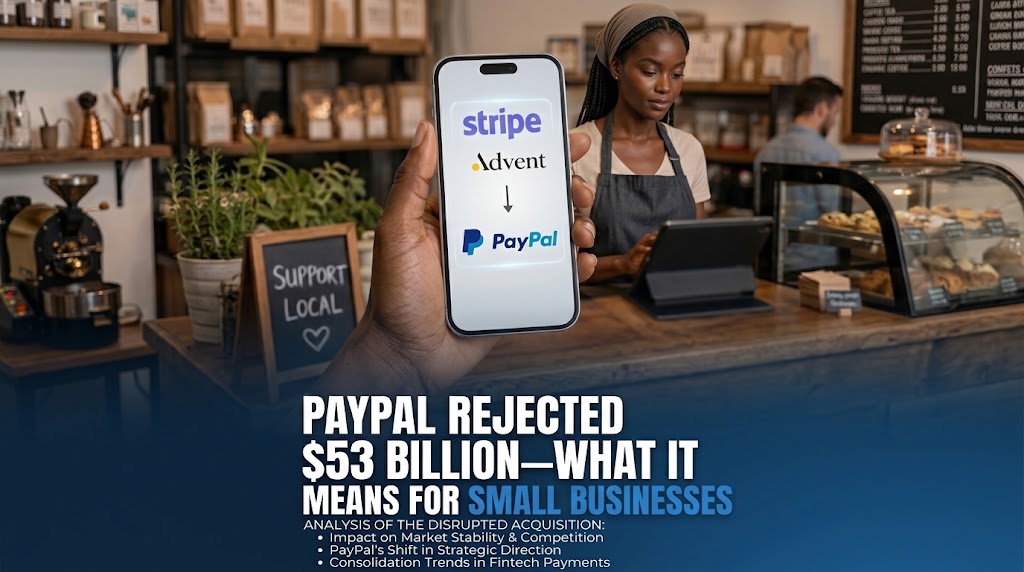
Stripe and Advent International have reportedly ended their attempt to acquire PayPal after a $60.50-per-share proposal valued the payments company at more than $53 billion. That removes the immediate possibility of a Stripe–PayPal combination, but it does not reverse PayPal's recent changes in Nigeria or eliminate the broader opportunity for better cross-border payment infrastructure across Africa.
The possibility of Stripe acquiring PayPal had raised an intriguing question for Africa: could combining two major global payment networks eventually make it easier for freelancers, creators and businesses to receive international payments? That acquisition now appears to be off, but the payments problem that made the proposed deal interesting has not disappeared.
Stripe and private equity firm Advent International have reportedly abandoned their pursuit of PayPal, ending at least for now, one of the biggest potential deals the global fintech industry had seen. Reuters reported on 28 August that the consortium had withdrawn after previously offering $60.50 per PayPal share, valuing the company at more than $53 billion. PayPal's board had reportedly considered that proposal inadequate, while financing and regulatory complications were also among the issues surrounding a possible transaction.
That means the scenario TechView Africa examined in our earlier article, Could Stripe Buying PayPal Finally Make Online Payouts Easier in Africa?, is no longer an active acquisition prospect based on the latest reporting. However, that does not mean nothing has changed for African PayPal users.
The deal went from a $53 billion bid to no deal
Reports of a serious Stripe–PayPal transaction emerged in July, when Stripe and Advent were said to have submitted a joint offer worth approximately $53.4 billion, backed by substantial committed financing. The proposal valued PayPal at $60.50 per share, but the company did not accept it. After PayPal reported stronger than expected second-quarter results, CEO Enrique Lores indicated that the company remained open to transactions capable of delivering superior shareholder value, without endorsing the Stripe–Advent price.
By mid-August, negotiations were reportedly still continuing and the possibility of a higher offer remained alive. That was the environment in which the original TechView Africa article examined what a combination could theoretically mean for African payments.
The situation has now changed. Axios reports that Stripe and Advent have ended the pursuit, while Reuters says both companies declined to comment publicly on the withdrawal. Stripe's own newsroom also contained no PayPal acquisition announcement when TechView Africa checked it. That distinction matters: the deal is being reported as abandoned, rather than having collapsed after a signed acquisition agreement. There was never a completed Stripe purchase of PayPal.
PayPal's share price shows how seriously investors took the takeover possibility
The market reaction was immediate. PayPal shares had closed at $61.47, already above the consortium's reported $60.50 offer price, before reports emerged that the pursuit had ended. Reuters subsequently reported that PayPal shares fell sharply in pre-market trading following the news.
That does not necessarily explain why Stripe and Advent walked away, but it illustrates one of the fundamental difficulties facing the proposal: PayPal's board believed the company was worth more than the price being offered.
PayPal is also attempting its own turnaround under CEO Enrique Lores, meaning its board had another option besides selling, try to improve the company independently.
What does this mean for Africa?
For African consumers, freelancers and online businesses, the immediate answer is simpler than the takeover headlines might suggest: nothing suddenly changes in your PayPal or Stripe account because the acquisition pursuit has ended.
The proposed transaction never reached the stage where Stripe controlled PayPal's products, pricing, geographical availability or account policies, so African users should continue judging each company's services based on what they actually offer in their country rather than what a hypothetical combined company might have provided. This is particularly important in Nigeria, where PayPal's own services have already been evolving independently of the Stripe negotiations.
Nigeria's PayPal changes are separate from Stripe
PayPal's current Nigeria support documentation says new Nigerian customers should link to a local partner to begin receiving money. Its documentation also explains that, in markets using the partner model, an eligible PayPal account can be connected to a licensed local bank or wallet partner for functions including transfers between the PayPal account and the local financial service.
PayPal's Nigeria withdrawal guidance similarly provides instructions for transferring available PayPal funds to a bank account, while warning that availability can differ between markets. These developments are important because Nigerian PayPal accounts historically faced more restrictions than users in many major markets, but they should not be credited to Stripe. They are PayPal product and partnership changes that exist regardless of whether Stripe ever acquires the company.
Africa still has the problem that made the proposed deal interesting
The takeover story attracted attention because Stripe and PayPal represent two different but potentially complementary parts of global digital payments. Stripe is deeply embedded in internet commerce infrastructure, while PayPal has a large consumer-facing payment network. Combining those systems raised obvious questions about whether international payments could eventually become easier across markets where receiving and withdrawing money remains more complicated. That possibility has now receded, but the underlying demand remains.
African freelancers increasingly work for overseas clients, creators earn from global audiences, software companies sell internationally and small businesses increasingly need payment infrastructure capable of moving money across borders without excessive friction. Whether those improvements eventually come from PayPal, Stripe, African fintech companies, banks or partnerships between several providers is a much bigger question than this one acquisition.
Could Stripe return with another offer?
It would be premature to say that Stripe could never pursue PayPal again. The current consortium has reportedly withdrawn its offer, which means there is no active acquisition to report based on the information available on 28 August. It does not create a permanent prohibition against Stripe, Advent or another buyer approaching PayPal in the future.
That is why TechView Africa would treat any renewed acquisition report as a new development requiring fresh verification, rather than assuming the original transaction has simply restarted. For now, however, readers should consider the Stripe–Advent pursuit ended.
Our Recommendation
African users should separate two stories that became intertwined during the takeover speculation. The first was a corporate deal: Stripe and Advent wanted PayPal, PayPal considered the reported offer insufficient, and the consortium has now reportedly walked away.
The second is much more relevant to everyday users: how quickly PayPal, Stripe and other payment providers improve the ability of Africans to receive, hold, convert and withdraw international payments. The first story may be over for now, but the second is not.
For Nigerian freelancers and businesses in particular, the useful development to watch is no longer whether Stripe buys PayPal, but whether PayPal's expanding local receiving arrangements become more widely available, easier to use and competitive in cost, while Stripe and other providers continue expanding their own African payment infrastructure. A $53 billion takeover would have been spectacular. Better cross-border payments would be considerably more useful.
Sources & Verification
Reuters — Advent-Stripe consortium said to drop pursuit of PayPal, Bloomberg News reports
Axios — Stripe, Advent end PayPal pursuit
PayPal Help (NG) — How do I accept payments with PayPal?
PayPal Help (NG) — How do I withdraw money to my bank account?
Reuters — PayPal shares fall after report of Advent-Stripe consortium abandoning takeover
Frequently asked questions
Did Stripe buy PayPal?
No. Stripe did not acquire PayPal. Stripe and Advent International reportedly made a joint offer, but the transaction was never completed and the consortium has now reportedly ended its pursuit.
How much was Stripe and Advent's PayPal offer?
The reported proposal was $60.50 per PayPal share, valuing PayPal at more than $53 billion.
Why did the PayPal deal fail?
PayPal's board reportedly considered the offer inadequate, while regulatory and financing complications were also associated with the proposed acquisition. Neither Stripe nor Advent has publicly provided a detailed explanation for abandoning the pursuit.
Could Stripe still buy PayPal later?
It is possible that circumstances could change, but there is currently no active acquisition that TechView Africa can verify. Any future proposal should be treated as a separate development.
Does the failed deal affect PayPal users in Nigeria?
Not directly. Stripe never took control of PayPal, so PayPal's current Nigerian services remain PayPal's own products and partnerships.
Can Nigerian PayPal users receive money now?
PayPal's current Nigerian support pages say new Nigerian customers should link to a partner bank to start receiving money. Availability and functionality can vary, so users should verify the current options available to their specific account.

Inside the $213 Billion Payments Business Airtel Wants to Take Public
Africa Is Connecting Payment Systems: What That Could Eventually Change for Consumers
Could Stripe Buying PayPal Finally Make Online Payouts Easier in Africa
CBN’s January 2027 Data Rule: What Nigeria’s Banks and Fintechs Actually Have to Move
OPay Says It Is Not Shutting Down in Nigeria, Here’s What Customers Should Know

What Happens to Customer Money When a Fintech App Shuts Down?
Why Nigerians Are Using Stablecoins for Cross-Border Payments and What the Risks Are
Follow TechView Africa on WhatsApp
Get TechView Africa updates on WhatsApp. Follow our channel for practical technology news, product guides and digital trends from Nigeria and across Africa.
Leave a comment
Comments cannot be edited or deleted after posting. Please review your comment before submitting.
No comments yet. Start the conversation.