

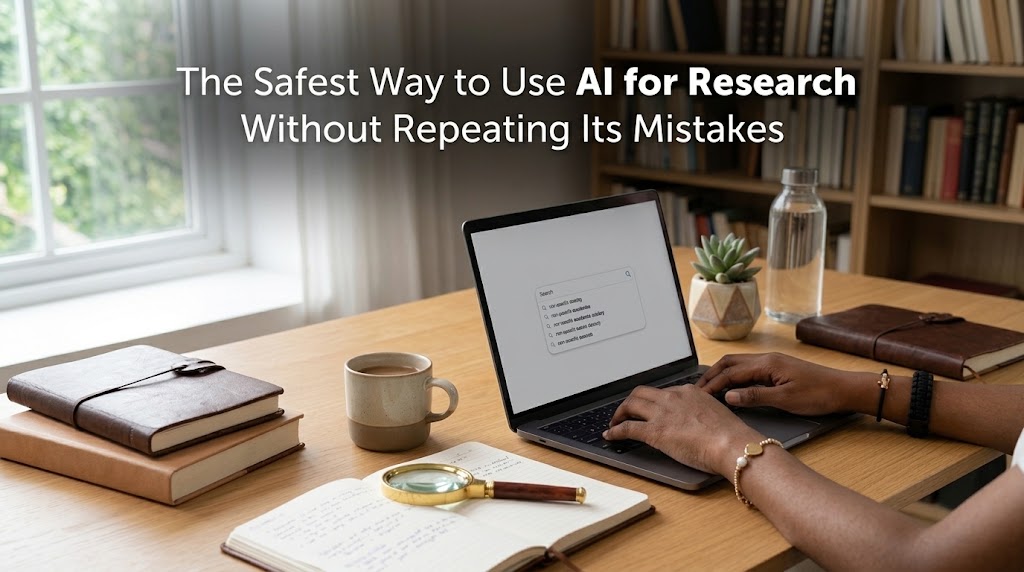
AI works best as a research assistant rather than the final authority. Use it to explore a subject and organise your thinking, but verify important facts, statistics, quotations and citations using the original sources.
The Right Way to Use AI for Research Without Spreading Its Mistakes
AI can make research considerably faster, but a polished answer is not necessarily an accurate one. The safest approach is to use AI to find questions, organise information and understand difficult material while checking important claims against the original sources.
Use AI as a research assistant, not as the final authority. It can help you generate search terms, break down unfamiliar topics, compare arguments and organise notes, but every important factual claim should be checked against the original source before it enters an assignment, article or report.
That distinction matters because generative AI can produce information that sounds polished while still being wrong. The US National Institute of Standards and Technology describes this problem as “confabulation”, where generative AI confidently produces erroneous or false content, while OpenAI similarly warns that language models can generate incorrect facts and even fabricated quotations, studies or references.
Start with AI for discovery, not evidence
A useful workflow is to ask AI what you should investigate rather than asking it to write the conclusion for you. For example, if you are researching why mobile data costs vary across African markets, AI might suggest areas such as spectrum policy, infrastructure, taxation and competition; you can then look for evidence from regulators, official statistics, research papers and credible reporting. This keeps the model in a role where mistakes are easier to catch. It is safer to let AI help generate research questions than to assume that every number, date or citation in a finished response is reliable.
Open the source yourself
If an AI tool gives you a link, paper title or quotation, do not stop at the generated answer. Open the source and check that it actually exists, says what the AI claims it says, is recent enough for your topic and comes from an organisation or author worth relying on.
That is especially useful when researching Nigeria. If a claim involves GDP, employment or other national statistics, compare it with information published by the National Bureau of Statistics. National Bureau of Statistics If the subject involves Nigerian technology policy or AI governance, look for the relevant government agency or original policy document rather than citing an AI-generated summary. Nigeria's NCAIR, for example, publishes information about the country's AI research and policy work.
A summary is not the original research
AI can be useful for explaining a difficult academic paper in simpler language, but its summary remains an interpretation. Before relying on it, read the paper's abstract, methodology, results and limitations yourself, particularly when the research is central to your argument.
UNESCO's guidance on generative AI in education and research promotes a human-centred approach that includes human oversight and appropriate validation of AI use. In practical terms, AI can accelerate understanding, but responsibility for the final research still belongs to the person submitting or publishing it.
Keep a verification trail
For every important claim, record the original source, publication date and what you verified. If AI helped you discover the source, that is fine; your evidence should still point to the original material rather than the AI's retelling of it.
This also makes it easier to revisit your work and distinguish information obtained from official data, peer-reviewed research, interviews and secondary reporting. More importantly, it reduces the chance of an AI-generated error being copied into another assignment, article or presentation.
Our Recommendation
The safest research habit is straightforward: use AI to ask better questions, organise information and understand difficult material, then verify the answers outside the AI system.
Do not treat confidence, detail or fluent writing as proof of accuracy. Before submitting academic work or publishing an article, check important names, dates, statistics, quotations and citations against the original material, while also following your school, employer or publisher's rules on AI use. AI can make research faster. It should not be allowed to decide what is true.
Sources & Verification
National Bureau of Statistics Nigeria
NIST — Artificial Intelligence Risk Management Framework: Generative AI Profile
OpenAI — Does ChatGPT Tell the Truth?
UNESCO — Guidance for Generative AI in Education and Research
Frequently asked questions
Can I cite an AI answer as a source?
For most research, it is better to cite the original document, dataset, study or organisation behind the information and follow the citation requirements set by your school or publisher.
Can AI create fake academic references?
Yes. Generative AI can produce references that appear credible but do not exist, which is why OpenAI itself recommends verifying important information and sources.
Is AI useful for academic research?
Yes. It can be useful for brainstorming questions, simplifying unfamiliar concepts, generating search terms and organising notes, but unverified AI output should not be treated as evidence.

Google Is Giving Nigerian Students Google AI Plus Free for One Year: Here’s How to Claim It
Meta Wants Muse to Help Run Small Businesses. Here’s What Owners Should Keep Under Human Control
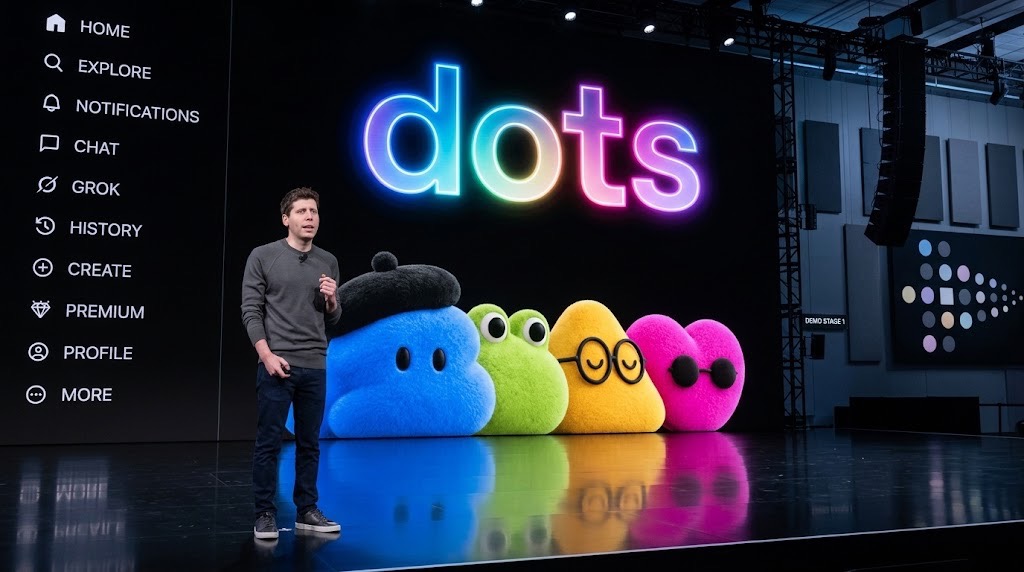
OpenAI’s Dots Can Keep Working After You Leave ChatGPT. That Changes What Using AI Means

50 Remote AI Jobs and Expert Projects Open Across Micro1, Mercor, Outlier and Handshake AI

16,326 Supabase Databases Had Readable Tables. The AI App Boom Is Scaling an Old Security Mistake
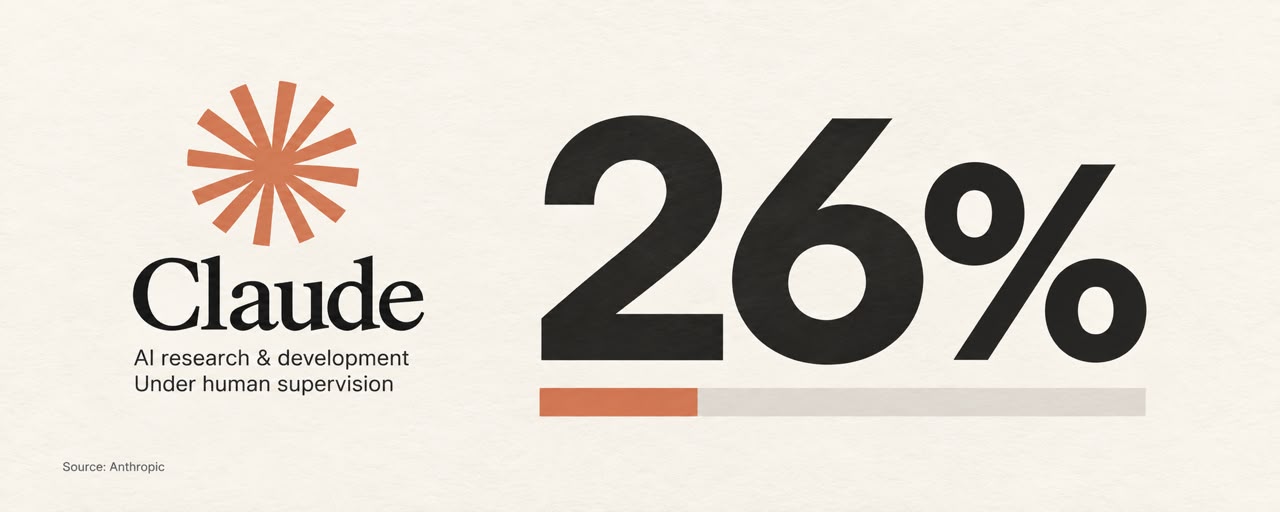
Claude Went From Leading Under 1% of Anthropic’s AI R&D to 26% in Six Months. Here’s What That Means

As AI Agents Gain More Control, Cybersecurity Rules Are Being Rewritten
Follow TechView Africa on WhatsApp
Get TechView Africa updates on WhatsApp. Follow our channel for practical technology news, product guides and digital trends from Nigeria and across Africa.
Leave a comment
Comments cannot be edited or deleted after posting. Please review your comment before submitting.
No comments yet. Start the conversation.