

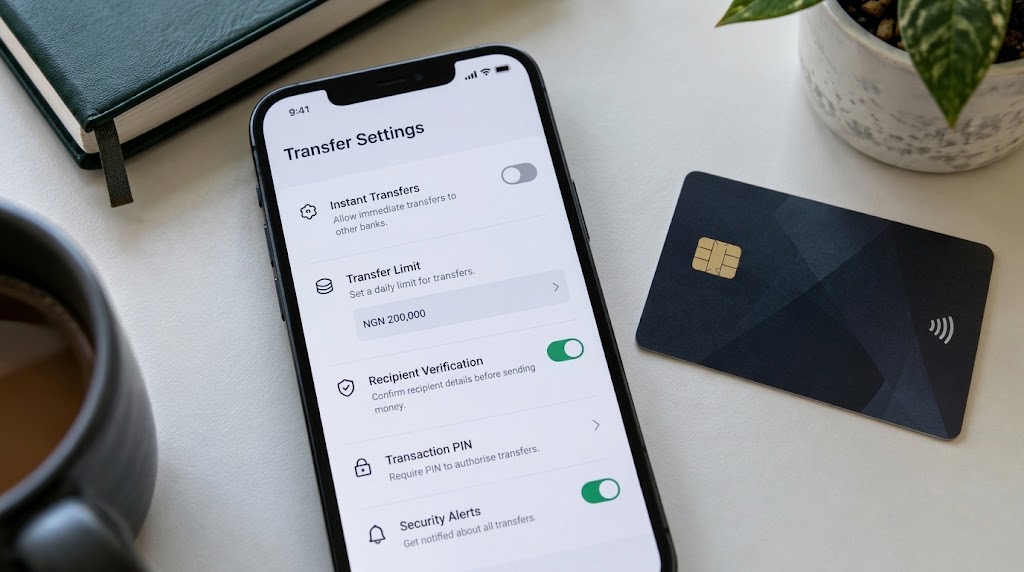
Nigeria's instant-payment opt-out gives customers a way to restrict outgoing digital transfers without closing their accounts. Similar security tools exist elsewhere in Africa, but card locks, transaction limits and fraud-response measures should not be confused with the same regulatory protection.
Can You Switch Off Bank Transfers in Nigeria? What CBN's New Rules Allow
Yes. Under Central Bank of Nigeria rules effective 1 July 2026, customers must be able to disable and re-enable outgoing online instant transfers. The restriction requires multi-factor authentication and still permits transfers made physically at the financial institution. It does not automatically freeze the entire account.
A bank account is supposed to keep money accessible. But what if you want to make it temporarily difficult to transfer that money online?Perhaps you rarely move funds from a particular account. Or you want an additional safeguard against unauthorised transfers without closing the account altogether.
Nigeria's banking rules now provide for that choice. Under a Central Bank of Nigeria directive issued on 12 March 2026, banks and other financial institutions offering instant payments must allow customers to voluntarily disable and re-enable the service.
The requirement took effect on 1 July 2026, introducing a customer-controlled restriction that is different from the account freezes banks impose during fraud investigations.
The provision is particularly relevant as digital payments become increasingly routine across Nigeria. But how does it actually work, and do customers elsewhere in Africa have similar options?
What Happens When You Disable Instant Bank Transfers?
The CBN describes the feature as Voluntary Opt-Out/Opt-In. Customers who opt out cannot initiate online instant transfers from the affected account to another customer, whether the recipient uses the same financial institution or a different one.
However, the directive allows customers to visit their financial institution physically to make transfers while the restriction remains active. That distinction is important.
| Banking activity | What the CBN rule provides |
|---|---|
| Online instant transfers to another bank | Blocked during opt-out |
| Online instant transfers within the same bank | Blocked during opt-out |
| Transfers made physically at the institution | Still permitted |
| Re-enabling instant payments | Allowed with multi-factor authentication |
| Receiving money | Not expressly prohibited by the opt-out provision |
| ATM withdrawals and card payments | Not specifically covered by this provision |
In other words, the feature does not automatically convert an ordinary bank account into one where no money can enter or leave. It specifically addresses outgoing online instant transfers. Other transaction types may be governed by separate banking controls.
How Can Nigerian Customers Switch Off Bank Transfers?
Although the CBN requires financial institutions to provide the functionality, it does not prescribe one universal banking-app interface.
Consequently, customers should not assume that every Nigerian banking app contains a button labelled "Disable Transfers".
A practical approach is to:
- Open your bank's official mobile application or internet banking platform.
- Check the account-security, transfer-settings or transaction-limit sections for an instant-payment opt-out facility.
- If the option is unavailable or unclear, contact the bank through its verified customer-service channel.
- Ask specifically for the voluntary instant-payment opt-out provided under the CBN's March 2026 directive.
- Complete the required authentication and request confirmation that the restriction is active.
The regulatory obligation is established, but the precise customer experience still depends on the institution.
Can You Turn Instant Transfers Back On?
Yes. The CBN requires financial institutions to allow customers to opt out and opt back in at any time and for a chosen period.
Both actions must be protected by multi-factor authentication. Consider someone who keeps savings in an account they rarely use for payments. Disabling instant transfers could make it less convenient to move those funds impulsively or without authorisation.
When an online transfer becomes necessary, the customer can request reactivation and complete the required verification.
There is a practical trade-off: the additional restriction may make urgent transfers less convenient. For this reason, customers should understand their bank's reactivation process before relying on the feature.
What If You Only Want to Reduce Your Transfer Limit?
Disabling transfers completely is not the only option. The same CBN directive requires financial institutions to permit voluntary adjustments to transaction limits, subject to appropriate checks and multi-factor authentication.
The existing regulatory maximums remain ₦25 million for individuals and ₦250 million for corporate customers.
These figures are ceilings, not guaranteed limits for every account. Individual banks may impose lower thresholds depending on the account and applicable requirements.
For someone who regularly sends money but wants to reduce the amount that could leave the account in one day, a lower personal transfer limit may be more practical than disabling instant payments. The choice depends on how frequently the account is used and how much inconvenience the customer is prepared to accept.
How Does Nigeria Compare With Ghana, Kenya and South Africa?
Nigeria's arrangement raises a wider question: how much control do African customers have over the movement of money from their accounts? The answer varies by country, financial institution and payment service.
Ghana: Transaction limits and account verification
The Bank of Ghana operates a tiered regulatory framework for mobile-money accounts and merchants. Its March 2025 notice on revised merchant account limits aligns merchant categories with different Know Your Customer (KYC) levels.
These controls determine permitted account balances and certain transaction thresholds. They are not the same as Nigeria's customer-controlled instant-transfer opt-out.
Kenya: Protecting M-PESA access
Kenya's Safaricom provides M-PESA security guidance advising customers to change a compromised PIN, protect personal information and contact the provider when fraud is suspected.
These are important protections for mobile-money users. However, the guidance does not establish an equivalent nationwide right to voluntarily suspend all outgoing instant bank transfers.
South Africa: Bank-specific transaction controls
South Africa offers a different example through Absa. Its banking application allows customers to adjust certain daily limits and temporarily lock selected card transaction types.
These controls can reduce exposure to unauthorised card activity, but temporarily locking a card is not necessarily equivalent to disabling all outgoing instant transfers from a bank account.
The difference is summarised below.
| Country | Documented control | Important limitation |
|---|---|---|
| Nigeria | Voluntary opt-out of instant transfers under CBN rules | Does not freeze every account activity |
| Ghana | Tiered mobile-money and merchant limits | Not an equivalent transfer opt-out |
| Kenya | M-PESA PIN security and fraud-response measures | Not a general transfer-disable requirement |
| South Africa | Absa card locks and adjustable limits | Bank-specific, not a nationwide equivalent |
These examples are not an exhaustive comparison of each country's banking regulations. They demonstrate why limiting a transaction, locking a card and suspending instant bank transfers are three different protections.
For African consumers, the practical question is therefore not simply whether their bank offers security settings, but exactly which payment channels those settings restrict.
Can Disabling Transfers Prevent Bank Fraud?
The Nigerian opt-out feature could make some forms of unauthorised outgoing instant payment harder while the restriction remains active.
For example, if someone obtains access to a customer's online banking credentials, a functioning transfer restriction may prevent an immediate payment through the affected channel.
But it would be misleading to call the feature complete fraud protection. It does not automatically secure compromised credentials, reverse completed transactions or prevent every kind of unauthorised account activity.
It is also different from a bank restricting an account because of suspected suspicious activity. TechView Africa has previously explained why Nigerian banks sometimes restrict accounts after unusual transactions. And if money has already been sent to the wrong recipient, the issue requires a separate recovery process. Our guide on what to do after sending money to the wrong Nigerian bank account explains the steps involved.
What If Your Bank Does Not Offer the Opt-Out Feature?
Because the CBN's implementation date has passed, customers can ask their financial institutions how the required functionality is provided.
Start with the bank's official complaints channel and specifically reference the 12 March 2026 circular on Additional Functionalities for Instant Payment.
Ask whether the facility is available through the mobile app, internet banking, a branch or another authorised channel.
An absent button does not necessarily establish non-compliance. However, the institution should be able to explain how customers can exercise the control.
If the bank does not satisfactorily address the matter, follow the CBN's consumer complaint procedure. It requires customers to approach their financial institution first and allows escalation after the applicable complaint-resolution period. Keep a record of the request and any reference number provided.
Our Recommendation
For Nigerian customers who frequently make digital payments, lowering transaction limits may offer a sensible balance between convenience and security.
For accounts that rarely need outgoing digital transfers, the voluntary opt-out feature could provide an additional layer of control.
Customers in Ghana, Kenya, South Africa and elsewhere should similarly examine the specific protections offered by their banks or mobile-money providers, rather than assume every security feature achieves the same result.
The broader lesson is that financial security increasingly involves more than protecting a password. It also means understanding and controlling the payment functions connected to an account.
Nigeria's new provision offers a clear regulatory basis for that control. How easily financial institutions allow customers to exercise it remains an important practical question.
Sources & Verification
Central Bank of Nigeria — Reforms and Instant-Payment Guidance
Bank of Ghana — Revised Merchant Account Limits
Frequently asked questions
Does disabling instant transfers stop people from sending money into my account?
The CBN's opt-out provision addresses outgoing online instant transfers. It does not expressly prohibit incoming payments. Customers should confirm the treatment of other payment channels with their institutions.
Can I disable instant transfers temporarily?
Yes. The CBN provides for voluntary opt-out and opt-in at any time and for a chosen period, subject to multi-factor authentication.
Do Ghana, Kenya and South Africa have the same rule?
The cited Ghanaian, Kenyan and South African sources document different security measures. They do not establish a general regulatory requirement equivalent to Nigeria's voluntary instant-transfer opt-out.
Inside the $213 Billion Payments Business Airtel Wants to Take Public

Fake Bank Alert or Real Payment: Here’s How to Verify It Properly
CBN’s January 2027 Data Rule: What Nigeria’s Banks and Fintechs Actually Have to Move

Sent Money to the Wrong Account in Nigeria? Act Fast, Here’s What to Do
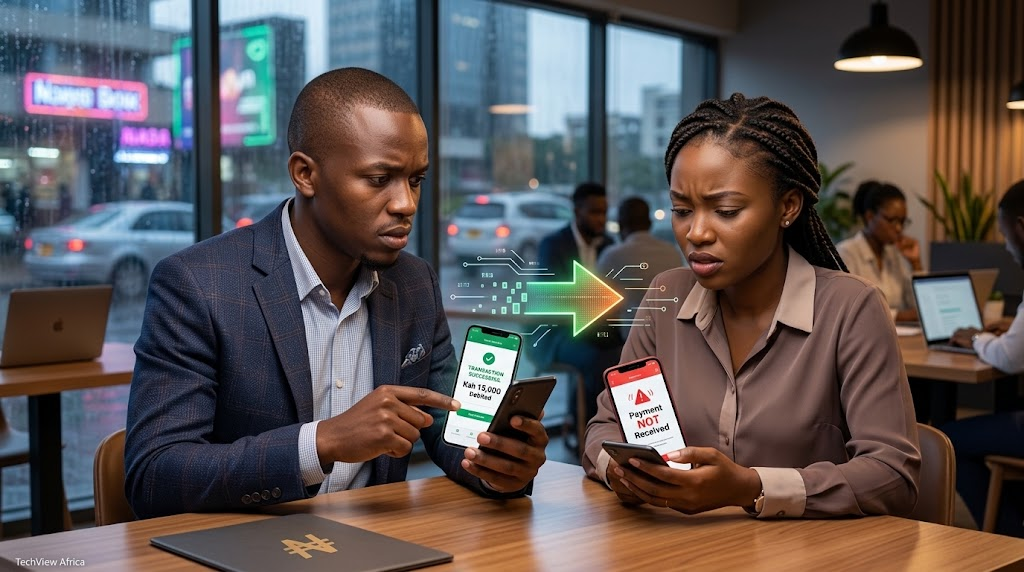
Debited but the Receiver Wasn’t Credited? Here’s What May Be Happening

Why Nigerians Are Using Stablecoins for Cross-Border Payments and What the Risks Are
Africa Is Connecting Payment Systems: What That Could Eventually Change for Consumers
Follow TechView Africa on WhatsApp
Get TechView Africa updates on WhatsApp. Follow our channel for practical technology news, product guides and digital trends from Nigeria and across Africa.
Leave a comment
Comments cannot be edited or deleted after posting. Please review your comment before submitting.
No comments yet. Start the conversation.