


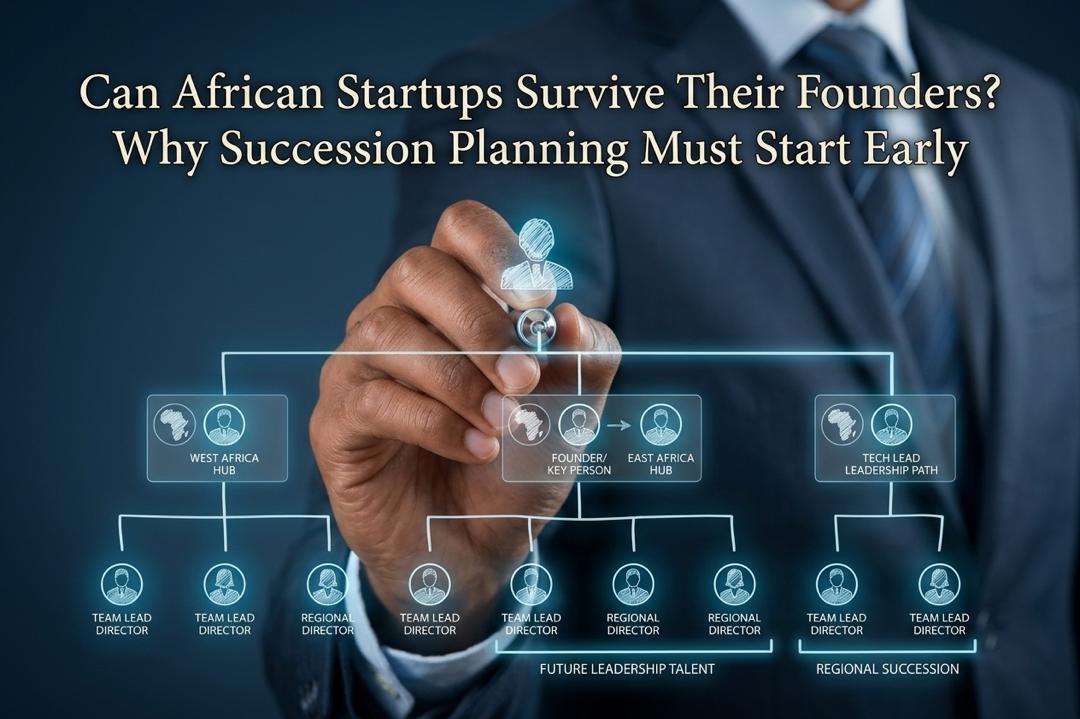
Startup succession planning is about more than finding a replacement CEO. African founders must ensure that management authority, board oversight, ownership responsibilities and institutional knowledge can transition without disrupting the business. NVIDIA, Chams and Paga illustrate why companies should build leadership continuity before an unexpected departure exposes their dependence on one individual.
A founder's departure should not become a company's emergency. NVIDIA's leadership transition, Chams' founder retirement and Paga's restructuring show why African technology businesses need to plan not only who leads next, but what authority, oversight and ownership must move.
A founder can be a company's chief executive, board chair, largest shareholder, product authority and most important customer contact at the same time. When that person steps back, replacing the CEO may solve only one part of the problem.
The more useful question for African startups is: which parts of the business depend on the founder, and who is authorised to take them over? Succession planning is not a single appointment. It involves separate transfers of management, governance, ownership and institutional knowledge.
NVIDIA shows why a CEO change is only one part of succession
On 12 November 2026, NVIDIA announced that founder Jensen Huang had resigned as president, CEO and a member of its board, effective immediately. Its regulatory filing says the board accepted the resignation on 11 November. Chief Financial Officer Colette Kress, who joined in 2013, became interim CEO while retaining the finance role. The board appointed Harvey C. Jones as its first chair and said it would consider internal and external candidates for a permanent CEO.
NVIDIA's announcement did not state why Huang resigned. The company said it expected operations, customer commitments and its product roadmap to continue without interruption. That is the board's stated expectation, not independent evidence of how the transition will perform.
The appointments reveal a separation of roles: an existing executive takes interim management responsibility, while a separate director leads the board. The filing does not establish what happened to Huang's shareholding or any influence he may retain outside his former executive and director positions. Leaving the CEO role is not the same as transferring ownership or control.
Chams and Paga show two different African transitions
Chams HoldCo's June 2026 notice to the Nigerian Exchange said founder Sir Demola Aladekomo would be succeeded as board chairman by Segun Oloketuyi, effective 9 July, after a 40-year strategic leadership tenure and his retirement. The notice lists Mayowa Olaniyan as Group Managing Director. This is a founder-chair transition; it should not be misdescribed as a sudden CEO replacement.
Paga's April 2026 restructuring was different. Founder Tayo Oviosu moved away from day-to-day management of the Nigerian business to focus on group priorities, but remained Group CEO and chairman of the group and Nigeria boards. Ope Oyinloye became Group COO and acting CEO of Paga Nigeria, pending CBN no-objection. This was delegation and operating redesign, not a full founder exit.
Together, the cases show why the word succession can conceal different changes. A founder may leave executive management but retain board or shareholder control; another may retire from the board while an existing executive continues running the company; a third may simply delegate a business unit while remaining group chief executive.
The four handovers founders should plan
TechView Africa's practical succession framework asks founders and boards to examine four transfers. It is an editorial decision tool, not a formal governance standard.
1. Management authority
Who can run daily operations, approve spending, sign authorised commitments, manage staff and respond to urgent issues? Define decision limits and name deputies before an absence forces the question.
2. Board oversight
Who leads the board, challenges management and handles conflicts involving the founder? The board chair and CEO perform different jobs. Where a startup is not ready for a formal board, experienced independent advisers can provide challenge, but should not be presented as a substitute for statutory directors or required governance.
3. Ownership and control
Who owns the shares, holds voting rights and can appoint or remove directors? A founder's resignation does not automatically transfer equity, voting control or reserved rights. Shareholder agreements should address death, incapacity, disputes, vesting, buybacks and deadlock with appropriate legal advice.
4. Institutional knowledge and relationships
Can the company maintain its product, compliance, customer, banking, supplier and investor relationships if the founder is absent? Critical processes and contact histories should belong to the organisation, with secure access and more than one trusted executive able to manage important relationships.
For Nigerian entities within its scope, the Nigerian Code of Corporate Governance 2018 identifies succession planning for the board chair, managing director/CEO and senior management as a board responsibility. Startups should check which rules apply to their legal and regulatory status rather than assume every provision applies identically to every early-stage company.
What startups should do before they need a successor
At seed stage, founders can document essential processes, set a second authorised approver for critical decisions and make sure company records and systems are not dependent on personal accounts.
As the company grows, it should develop a management bench, delegate customer and regulatory relationships, clarify the boundary between board and executive decisions, and review shareholder arrangements. Stronger internal systems also help startups earn institutional trust; see TVA's analysis of why African startups struggle to win their first enterprise customer.
For regulated or larger businesses, succession should become a board-reviewed process. The company should identify interim leaders, understand approval or notification requirements, plan stakeholder communications and test whether critical services can continue during an unplanned leadership gap.
Investors should assess more than the founder's personal track record. Venture capital due diligence should examine whether the company has capable deputies, documented authority, reliable controls and a realistic continuity plan. The aim is not to weaken founder leadership; it is to reduce the risk that the investment depends on one person's permanent availability.
Our Recommendation
Founders should map four things separately: who runs the business, who oversees it, who controls it and where its essential knowledge and relationships sit. Revisit that map as the company hires, raises capital, enters regulated markets or expands across borders.
The strongest founder-led businesses do not become less ambitious when they share responsibility. They become less fragile. A company is ready for its next stage when the founder can step away from daily decisions without leaving the organisation unable to act.
Sources & Verification
NVIDIA — Official CEO transition announcement
Frequently asked questions
1. What is succession planning in a startup?
Startup succession planning is the process of preparing a business for changes in leadership and responsibility. It involves identifying potential successors, delegating decision-making authority, documenting essential operations and ensuring that the company can continue functioning when its founder or another key executive leaves.
2. Why is succession planning important for African startups?
Many growing startups rely heavily on their founders for business decisions, investor relationships, product direction and daily operations. Without succession planning, an unexpected departure can disrupt management, customer relationships and business continuity. Preparing other leaders reduces this dependence and makes the company more resilient.
3. Is succession planning the same as replacing a CEO?
No. Replacing a CEO addresses executive leadership, while succession planning can also involve transferring board responsibilities, ownership rights, voting control and important institutional knowledge. A company may appoint a new CEO while its founder retains significant ownership or influence.
4. Can a founder step back without leaving the company?
Yes. A founder can delegate daily operational responsibilities while retaining a group leadership, strategic or board position. Paga's 2026 restructuring illustrates this arrangement: Tayo Oviosu retained his Group CEO and board chairman positions while Ope Oyinloye assumed additional operating responsibilities, including acting CEO of Paga Nigeria, subject to regulatory approval.
5. What is key-person risk in a startup?
Key-person risk is the possibility that a company's operations, decision-making or commercial relationships will be seriously affected when an individual with essential knowledge or responsibilities becomes unavailable. It can involve founders, technical leaders, financial controllers or other critical employees.
6. What should investors examine when assessing a startup's succession plan?
Investors should examine the management team's depth, delegated decision-making authority, board oversight, ownership arrangements, documented operations and the company's ability to maintain customer and regulatory relationships without its founder. These factors help reveal whether the business has developed institutional capabilities beyond one individual.

When Microsoft 365 Fails: The Cloud Continuity Plan African Businesses Need

Why African Startups Struggle to Win Their First Enterprise Customer Even After Building a Good Product

Lagos Life’s Virtual Billboards: Can a Nigerian Browser Game Build a Sustainable Business?

ChatGPT Ads Arrive in Nigeria: What ₦3,250 a Day Really Means

NDPC Registration in Nigeria: Does Your Business Need to Register?
MORENA AI Supports 12 African Languages, but How Accurate Is It?

SEO vs GEO: Before You Pay for AI Visibility, What Can It Actually Prove?
Follow TechView Africa on WhatsApp
Get TechView Africa updates on WhatsApp. Follow our channel for practical technology news, product guides and digital trends from Nigeria and across Africa.
Leave a comment
Comments cannot be edited or deleted after posting. Please review your comment before submitting.
No comments yet. Start the conversation.