

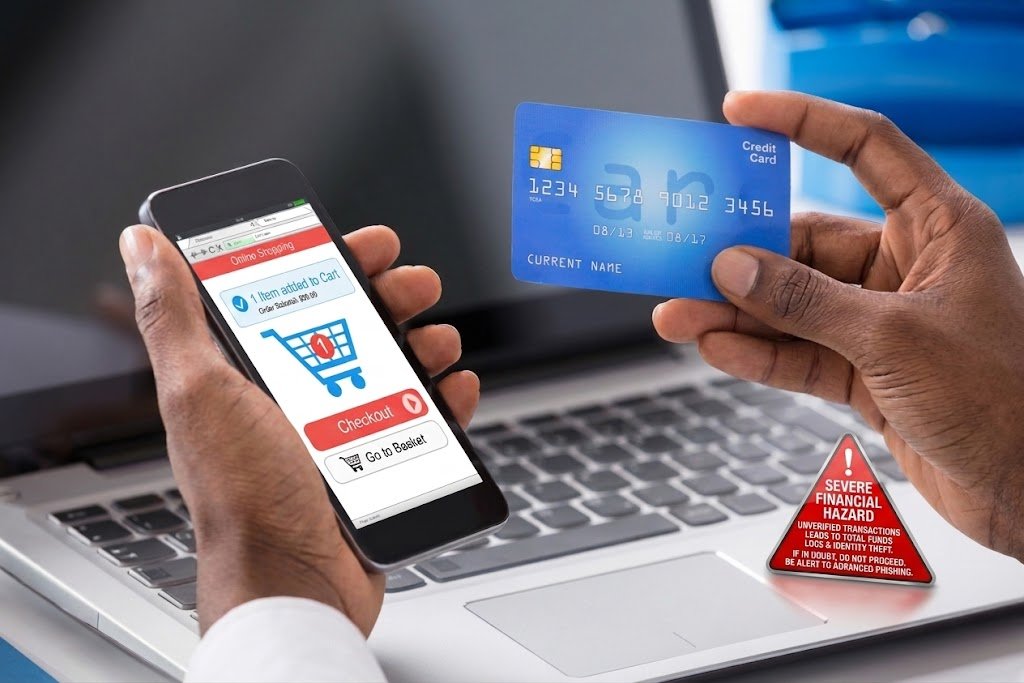
A real-looking shop is not enough. Verify several independent signals and use a payment method with protection when one is available.
The Instagram page looks polished. The website has a padlock. The seller has thousands of followers and screenshots of happy customers. None of that proves the store is genuine. Before transferring money to an online seller, especially one you have never used before, spend a few minutes checking the business behind the page.
Before paying an unfamiliar online store, check more than its Instagram followers or website design.
A safer verification should include:
- Searching the business independently
- Checking its CAC registration where applicable
- Comparing its prices with established retailers
- Looking beyond reviews displayed by the seller
- Checking how old and established the website appears to be
- Verifying the payment-account name
- Reading the delivery and refund terms
- Testing the phone number, email and physical address
- Using a payment method that gives you some dispute protection where possible
- Saving evidence before sending money
No single check proves that a seller is legitimate.
What matters is whether the pieces fit together.
A professional looking website proves surprisingly little
Creating a convincing online store is easier than ever. A seller can buy a domain, install a professional e-commerce template, copy product images from manufacturers, create social-media accounts and begin advertising within hours. Scammers can do the same.
The US Federal Trade Commission has repeatedly warned that fraudulent online shops may impersonate known brands, advertise unusually large discounts and use copied photographs and logos to appear legitimate. Buyers may receive a counterfeit product, something completely different or nothing at all. This is why appearance should be one of the weakest factors in your decision. A beautiful website can belong to a legitimate company. It can also belong to a scammer who launched it yesterday.
TechView takeaway: Do not ask, “Does this store look real?” Ask, “Can I independently verify that the business behind it is real?”
1. Search for the store outside its own platforms
Start with the simplest test. Search the business name separately rather than relying on information the seller sends you. Try combinations such as the company's name alongside terms like: review, complaint, scam, delivery, refund or fraud.
The FTC specifically recommends researching unfamiliar online sellers this way before buying. Do not stop at the first page of positive results. Look for patterns. One angry customer does not prove a business is fraudulent. Even excellent retailers occasionally deliver late or handle a complaint badly. But repeated reports describing the same behaviour should concern you for example, customers claiming they paid and were blocked, received counterfeit products or could no longer reach the business. Also search the exact website address. A scammer may create a shop whose name resembles a legitimate business closely enough to confuse buyers.
2. Check the business with Nigeria's Corporate Affairs Commission
For Nigerian businesses claiming to be formally registered, the Corporate Affairs Commission provides a public company search facility. The CAC says its company search service can be used to verify registration status and company information.
Verification: CAC Company Search
You can also use the Commission's public search portal to look for an entity by name or registration number.
Verification: CAC Public Search Portal
Check whether the name advertised by the store matches a registered business. If the seller displays a CAC or RC number, search it rather than assuming the number is genuine.
But there is an important limitation:
CAC registration does not guarantee that a store will treat you honestly.
It proves that an entity matching the registration exists. It is not a consumer-satisfaction certificate. A scammer could potentially misuse another company's details, while a registered business can still provide terrible service. Treat CAC verification as one part of your investigation not the final answer.
3. Compare the price with reality
Price is often where common sense disappears. Suppose several reputable Nigerian stores sell a new smartphone for around ₦700,000. An unfamiliar Instagram shop suddenly advertises it for ₦320,000. That is not automatically a bargain. It is a question. Why is the seller able to undercut everyone else by more than half? There may occasionally be a legitimate explanation: clearance stock, an older version, open-box goods or a promotion. But the larger the price difference, the stronger the evidence you should demand.
The FTC identifies unusually low prices for well-known products as a common warning sign in fake online shopping schemes. Be particularly careful when the seller combines an extraordinary discount with urgency:
“Only two left.”
“Payment must be made in the next 10 minutes.”
“Promo ends immediately.”
Pressure is useful to scammers because checking takes time. A genuine bargain can normally survive five minutes of verification.
4. Do not trust testimonials the seller controls
Screenshots of WhatsApp messages are among the easiest forms of “evidence” to manufacture. So are Instagram comments. So are photographs showing packages allegedly being delivered. Even follower counts deserve caution. A page with 80,000 followers may appear more trustworthy than one with 800, but followers can be purchased and accounts can change ownership.
Look for evidence outside the seller's control. Search independent review platforms, forums, social networks and Google results where available. Look for customers discussing the business naturally over time. Also examine negative reviews intelligently. If twenty accounts all posted five-star reviews this week using similar language, that deserves scrutiny.
A genuine business often has an imperfect history: different writing styles, photographs from actual customers and occasional complaints followed by responses. Strangely perfect can sometimes be less reassuring than realistically good.
5. Check when the website appeared
If the seller operates a standalone website, its domain history can provide another clue. ICANN provides an official registration-data lookup service for many domain names using RDAP, the modern replacement for traditional WHOIS queries.
Verification: ICANN Domain Lookup
Enter the store's domain name and inspect the information available. A website claiming: “Nigeria's trusted electronics retailer since 2016” deserves additional investigation if its domain was registered three weeks ago. That does not automatically prove fraud. A legitimate company may have changed domains or launched a new website. Likewise, privacy protection can hide some registrant information legitimately. Domain age is therefore another signal, not a verdict. What matters is whether the store's story matches the evidence.
6. The padlock does not mean the seller is trustworthy
Many people still believe that seeing HTTPS or a padlock beside a web address proves that the business is legitimate. It does not. HTTPS encrypts the connection between your browser and the website. Google explains that HTTPS helps prevent eavesdropping and interference with information travelling between you and the site. That is important security. But criminals can also obtain HTTPS certificates. A scam website can therefore have a perfectly valid padlock. Think of HTTPS as securing the road between you and the shop. It does not prove that the shopkeeper at the end of that road is honest.
7. Check whether the website has known security warnings
Google's Safe Browsing service examines billions of URLs and identifies sites associated with malware, phishing and other unsafe activity. Its Transparency Report includes a tool for checking a site's current status.
Verification: Google Safe Browsing Site Status
If Google already flags the site as dangerous, that is an obvious reason to stay away. But the reverse requires caution. A site returning no current warning is not proof that the business is genuine. A brand new fraudulent website may simply not have been detected yet. Security scanners can tell you something is known to be dangerous. They cannot certify that every unflagged shop will deliver your order.
8. Look carefully at the payment details
This is one of the most important checks for Nigerian buyers. Before making a transfer, read the recipient name displayed by your banking app.
Does it make sense?
If “Premium Mobile World Limited” suddenly asks you to transfer ₦850,000 into an unrelated personal account, ask why.
That mismatch is not automatic proof of fraud. Small businesses may use accounts that do not perfectly match their trading names. But the larger the transaction, the less comfortable you should be with unexplained inconsistencies. Ask the seller to clarify the account relationship before paying.
More importantly, be suspicious when a seller insists on a payment method designed to leave you with little practical recourse. The FTC's July 2026 fraud guidance warns that scammers often push victims toward payment methods that make recovery difficult, including bank transfers, cryptocurrency, payment apps and gift cards.
For international transactions, services offering genuine buyer protection can be preferable. PayPal, for example, warns that eligible Goods and Services transactions can receive Buyer Protection, while personal style Friends and Family payments do not carry the same protection.
Verification: PayPal guidance on payment scams
9. Test the seller before making an expensive purchase
A genuine business should normally be capable of answering reasonable questions. Ask about the exact model, warranty, delivery date, return policy or physical pickup. See how the seller responds. Vague answers become especially concerning when combined with demands for immediate payment. For high value purchases, independently verify any claimed physical store. Search the address separately. Look for it on maps. Check whether older customer posts mention visiting that location. If practical, ask whether collection is possible. A seller saying “we have stores nationwide” should be able to tell you where one is. Do not rely solely on an address typed into the seller's Instagram biography.
10. Read the refund policy before you need a refund
Many people investigate a store's refund rules only after the transaction goes wrong. Reverse the order.
Before paying, find out what happens if:
- The item never arrives
- The wrong product arrives
- The product is defective
- You receive a counterfeit
- You change your mind before dispatch
A genuine store should make its important sales terms reasonably understandable. The FTC similarly advises online shoppers to examine refund terms and keep records of the seller's shipping promises and communications. If the website contains no refund information, no identifiable business details and no meaningful customer-support route but happily accepts full payment that imbalance should concern you.
11. Keep evidence before sending money
Before paying an unfamiliar seller, take screenshots. Keep the product listing, price, seller name, payment instructions, refund promise and conversation. Save your receipt. Do not delete WhatsApp or Instagram messages simply because the purchase appears successful.
The FTC recommends keeping the company and website details, order information, seller promises, communications and payment records. In Nigeria, documentation is also useful if a consumer dispute later reaches the Federal Competition and Consumer Protection Commission.
FCCPC says consumers should initially engage the provider and, if the issue remains unresolved, can file a complaint with supporting transaction documents.
Verification: FCCPC consumer complaint procedure
What if you have already paid and become suspicious?
Act quickly. Contact your bank or payment provider immediately and explain that you suspect fraud. Ask whether the transaction can still be stopped, recalled, disputed or otherwise investigated. Do not continue sending money because the seller claims you must pay another “release fee,” “insurance charge” or “verification payment” before receiving your original purchase. Preserve every conversation and transaction record.
If the transaction is a genuine consumer dispute, contact the seller formally and keep evidence of the response. FCCPC provides an online complaint process where attempts to resolve the matter directly have failed. If you believe you are dealing with deliberate fraud rather than merely poor customer service, preserve the evidence for your bank, relevant platform and appropriate law enforcement channels.
Nigeria's ngCERT continues to classify phishing as a serious threat. Its June 2026 advisory described active phishing infrastructure capable of credential harvesting and warned that such campaigns may continue despite international disruptions.
Verification: Nigeria ngCERT security advisories
The 60-second TechView authenticity test
Before transferring money, pause and answer five questions:
Can I independently find the business?
Does its registration, history and contact information make sense?
Is the price believable?
Does the payment destination make sense?
If something goes wrong, is there a realistic way to complain, dispute the payment or locate the seller?
One weak answer does not necessarily prove fraud. Five weak answers are telling you something.
What this means
The biggest mistake in online shopping is searching for one magic sign that proves a store is genuine. There isn't one.
A CAC certificate can be real while the person using it is not connected to the company.
A website can have HTTPS and still be fraudulent.
Instagram reviews can be fabricated.
Followers can be bought.
A physical address can be copied.
Even a legitimate business can provide poor service.
The safest approach is verification by consistency.
Does the business name match the registration?
Does the website history fit the company's claims?
Do independent customers appear to exist?
Is the price realistic?
Does the payment account make sense?
Can you find real contact information?
Are the refund and delivery rules clear?
The more money you are about to send, the more verification you should demand. And when a seller pressures you with “Pay now before somebody else buys it,” remember this: Missing a suspicious bargain may cost you a discount. Sending money to the wrong person can cost you the entire purchase price. Check first. Transfer second.
Verification: FCCPC Complaint Handling
+ TechView | Digital Safety & Consumer Technology
+ Technology should make life easier, not make fraud easier. Stay informed, verify before you trust, and think before you pay.
Sources & Verification
Corporate Affairs Commission — Company Search
ICANN Domain Registration Lookup
Google Safe Browsing Site Status
PayPal guidance on payment scams
Federal Competition and Consumer Protection Commission — Complaints
Frequently asked questions
Does CAC registration prove that an online store is genuine?
No. It proves that a registered entity exists. It does not guarantee that the seller contacting you belongs to that company or that the business will complete your transaction honestly.
Is a newly registered website automatically a scam?
No. Genuine businesses launch new websites. But a new domain should raise questions if the company claims to have operated from that same website for many years.
Can I trust a store because it has thousands of followers?
No. Followers and engagement can be bought or manipulated. Give more weight to independent customer history, verifiable business information and consistent contact details.
Does HTTPS mean a store is safe?
HTTPS protects the connection between you and the website. It does not prove the merchant is trustworthy.
Should I pay by direct bank transfer to receive a discount?
Only if you have independently verified the seller and are comfortable with the reduced payment protection. Be particularly cautious if an unfamiliar seller pressures you to use an irreversible payment method.
What should I do if I have already paid and now suspect fraud?
Contact your bank or payment provider immediately, preserve all evidence and stop sending additional payments. If appropriate, report the seller to the platform involved and use relevant consumer-protection or law-enforcement channels.
Where can Nigerian consumers complain?
The Federal Competition and Consumer Protection Commission provides a consumer complaint process after attempts to resolve the issue directly with the seller.
Leave a comment
Comments cannot be edited or deleted after posting. Please review your comment before submitting.
Best Budget Smartphones for Students: What to Buy and What to Avoid
Fake Bank Alert or Real Payment: Here’s How to Verify It Properly

That Job Offer May Be a Scam, Watch Out For These Seven Signs People Ignore
Debited but the Receiver Wasn’t Credited? Here’s What May Be Happening
AI Sextortion: What to Do If Someone Threatens You With a Fake Explicit Image
Nigeria Is Turning SIM Swaps Into Bank Fraud Red Flags
Inside Nigeria’s Digital Fraud Problem: What 67,518 Cases and 2026 Cyber Alerts Reveal
Follow TechView Africa on WhatsApp
Get TechView Africa updates on WhatsApp. Follow our channel for practical technology news, product guides and digital trends from Nigeria and across Africa.
Wow so detailed!