

Beyond AI: Why the Next Technology Race Is About Superintelligence
Superintelligence, often called artificial superintelligence or ASI, describes a possible future AI capability beyond human-level AGI. Google DeepMind describes it as intelligence potentially more cognitively capable than large organisations of humans, while OpenAI says it is beginning to prepare for a transition towards superintelligence.
For years, artificial intelligence was the destination. Then the industry began talking seriously about artificial general intelligence, or AGI: systems able to perform a broad range of intellectual work at roughly human level. Now some of the organisations building frontier AI are already discussing what comes after that.
Google DeepMind published a major research paper in June examining the transition “From AGI to ASI,” while OpenAI said the same month that it is beginning a transition towards superintelligence. Neither statement means such a system exists today. But together they reveal how the industry's long-term ambition is shifting.
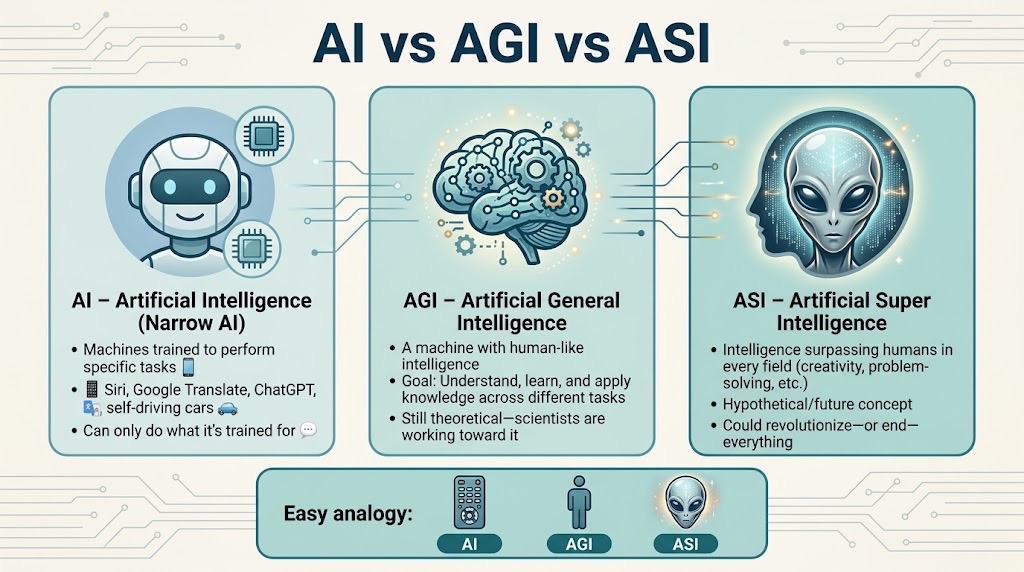
AI, AGI and ASI are not the same thing
Artificial intelligence is the broadest category. It includes everything from recommendation systems and image recognition to language models and increasingly capable AI agents.
AGI is more ambitious. Definitions differ, but the basic idea is a system capable of performing a wide range of cognitive tasks rather than being limited to one narrow domain.
Artificial superintelligence, or ASI, goes further again.
DeepMind’s 2026 research describes artificial general superintelligence as a system that could be more intelligent and cognitively capable than large organisations of humans, not merely better than an individual at isolated tasks. The researchers outline several possible routes from AGI to that point, including scaling existing systems, new AI paradigms, recursive improvement and large multi-agent systems. That remains theoretical research, not evidence that ASI has been built.
Why are AI companies talking about superintelligence now?
The immediate reason is that frontier systems are becoming capable of completing increasingly long and complicated tasks. OpenAI said in late 2025 that AI had progressed from software-engineering tasks taking humans seconds to tasks requiring more than an hour, and expected systems to continue handling longer-duration work. Its 2026 industrial-policy paper goes further, describing a future where systems could perform projects that currently take people months. Those are OpenAI’s expectations rather than guarantees about future progress.
The important shift is therefore not that existing AI has suddenly become superintelligent. It is that superintelligence has entered the planning horizon of organisations already spending enormous resources on frontier AI.
TechView Africa previously examined whether increasingly autonomous AI should be slowed down. That debate becomes harder if future systems move beyond assisting people towards outperforming the people expected to supervise them.
Superintelligence creates a supervision problem
Today’s AI systems can still be checked by people with sufficient expertise. A programmer can inspect generated code; a lawyer can review an AI-generated summary; a researcher can challenge a questionable conclusion.
A genuinely superintelligent system creates a more difficult problem: how does a less capable human reliably judge the work of something more capable than the human reviewer?
OpenAI has described this as a central alignment challenge. Its earlier superalignment research argued that techniques relying on human supervision may become inadequate if AI systems become substantially more capable than their supervisors.
That does not establish that loss of control is inevitable. It explains why researchers are studying the problem before the technology exists.
The nearer-term version is already visible with AI agents. TVA has documented why systems that can access files, browsers and workplace tools need carefully limited permissions. The more capable the system becomes, the more consequential those decisions become.
Africa cannot wait until ASI arrives to participate
For African countries, the most important question today is not predicting the year superintelligence will appear.
It is whether the continent builds enough compute capacity, skills, research capability, governance expertise and bargaining power to participate in whatever comes next.
The African Union’s Continental AI Strategy already calls for investment in infrastructure, talent, datasets, innovation and responsible governance. Nigeria’s National AI Strategy similarly treats AI capability as part of national economic and technological competitiveness.
Meanwhile, the labour market is already moving before superintelligence arrives. TechView Africa’s analysis of AI job listings across Africa found growing demand for agentic AI, model evaluation, deployment, guardrails and production systems not simply basic prompt writing.
The relevant preparation therefore starts long before ASI. AI is not becoming obsolete. It remains the umbrella technology underneath everything being discussed. But for some of the companies pushing the frontier, AI itself is no longer the final destination. Superintelligence is.
Our Recommendation
Treat superintelligence as a serious research and policy direction, but not as an existing technology or guaranteed outcome.
For workers and businesses, the practical priority remains learning how to use and supervise increasingly capable AI systems. For African governments and technology ecosystems, investment in compute, research talent, AI safety, infrastructure and representation in global governance discussions matters more than attempting to predict an exact ASI arrival date.
Sources & Verification
Google DeepMind — From AGI to ASI
OpenAI — Industrial Policy for the Intelligence Age
OpenAI — AI Progress and Recommendations
OpenAI — Weak-to-Strong Generalization
African Union — Continental Artificial Intelligence Strategy
Frequently asked questions
What is artificial superintelligence?
Artificial superintelligence, usually shortened to ASI, describes a hypothetical AI capability substantially beyond human-level general intelligence. There is no established ASI system today.
Is AGI the same as superintelligence?
No. AGI generally refers to broad human-level or comparable general capability. Superintelligence refers to systems substantially exceeding that level.
Does superintelligence exist already?
There is no established evidence that current publicly available AI systems meet the definition of artificial superintelligence. Current discussion concerns future capability trajectories and how society should prepare for them.
When will superintelligence arrive?
There is no reliable date. AI organisations and researchers publish different forecasts and scenarios, but the speed and pathway of future capability development remain uncertain.
Will superintelligence replace normal AI?
Not in the sense that AI disappears. Superintelligence would still be artificial intelligence; ASI describes a much higher capability level within the broader AI field.

We Checked 20 Humanoid Robot Deployments. Only Two Published Quantified Operating Results
Should We Slow Down AI? The Human Control Question Behind Autonomous Weapons, AI Agents and Superintelligence

We Opened Big King Media’s Source Code. This Free WordPress Media System Is Far More Serious Than We Expected
Meta Wants Muse to Help Run Small Businesses. Here’s What Owners Should Keep Under Human Control
OpenAI’s Dots Can Keep Working After You Leave ChatGPT. That Changes What Using AI Means

50 Remote AI Jobs and Expert Projects Open Across Micro1, Mercor, Outlier and Handshake AI

16,326 Supabase Databases Had Readable Tables. The AI App Boom Is Scaling an Old Security Mistake
Follow TechView Africa on WhatsApp
Get TechView Africa updates on WhatsApp. Follow our channel for practical technology news, product guides and digital trends from Nigeria and across Africa.
Leave a comment
Comments cannot be edited or deleted after posting. Please review your comment before submitting.
No comments yet. Start the conversation.