

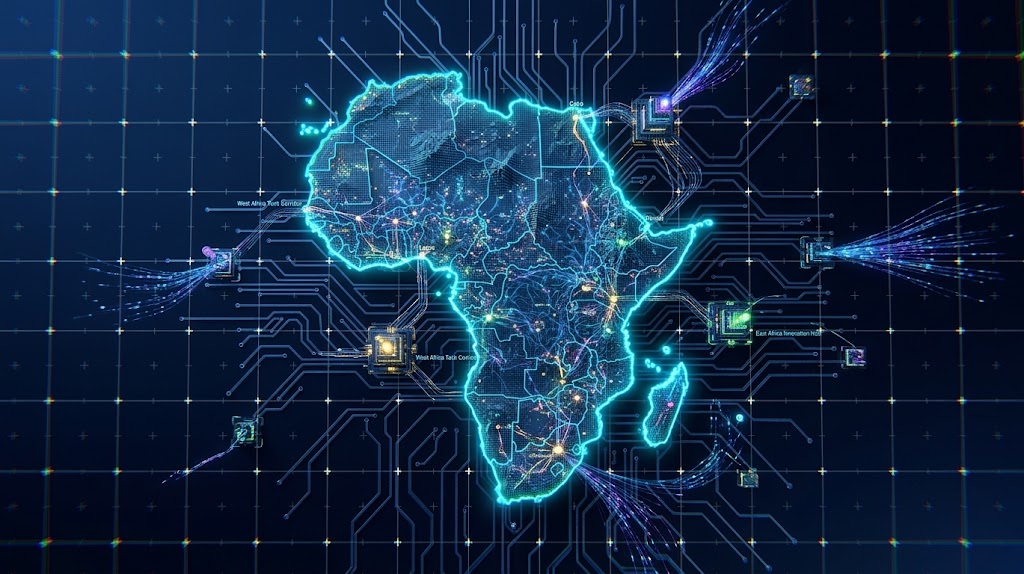
Africa holds only a small share of global data-centre capacity. As AI demand grows, reliable local computing infrastructure could become as important as AI skills and software.
AI may feel like software that lives in the cloud, but every model ultimately depends on physical servers, electricity, cooling and connectivity. As Africa tries to capture more value from artificial intelligence, data centres are becoming a critical part of the conversation.
Data centres are becoming one of Africa’s most important AI stories because they influence where computing happens, how quickly services respond and how much organisations depend on infrastructure outside the continent. The African Actors of Data Center Association’s 2026 economic report estimates that Africa represents only 0.6% of global data-centre capacity. It counted about 360 MW of active capacity, 238 MW under construction and 656 MW planned. Those numbers show growth, but also the size of the gap.
AI needs more than an internet connection
Using an AI application and having the infrastructure to run AI are different things. A startup in Lagos can access a model hosted thousands of kilometres away. That may work well for many uses. But organisations building services that require low latency, large datasets or tighter control over information have stronger reasons to keep computing closer to users.
The International Energy Agency says AI model training and deployment take place mainly in data centres. Its more recent 2026 energy and AI analysis found that global data-centre electricity demand rose 17% in 2025, while electricity use by AI-focused facilities increased even faster. Without enough local capacity, Africa can build impressive applications while still importing much of the computing power underneath them.
Investment is starting to reflect that
The shift is already visible. Google opened its first African Google Cloud region in Johannesburg in 2024, bringing more cloud infrastructure directly onto the continent. In Kenya, Microsoft and G42 announced a $1 billion digital investment initiative that includes plans for a new East Africa cloud region and a data-centre campus in Olkaria designed to use geothermal electricity.
Nigeria is expanding local infrastructure too. MTN Nigeria launched its Enterprise Cloud Platform and Sifiso Dabengwa Data Centre in Lagos in 2025. The GSMA’s Mobile Economy Africa 2025 report points to similar developments, including investments in data hosting, cloud partnerships and edge computing as operators prepare for more advanced digital and AI services.
These projects do not mean Africa suddenly has abundant AI computing capacity. They show that cloud, telecoms and data-centre investment are beginning to converge.
Electricity may be the real AI bottleneck
Africa’s biggest data-centre problem may no longer be simply getting enough fibre into a building. The African Actors of Data Center Association says power availability has overtaken connectivity as the main constraint on expansion. Servers must operate continuously. Cooling systems must remove the heat they produce. Enterprise customers expect uptime regardless of what is happening on the surrounding electricity grid.
For African markets already dealing with generation shortages, grid instability or expensive backup power, attracting AI infrastructure therefore creates a harder question: Can new facilities receive dependable electricity without worsening access or costs for everyone else?
Kenya’s proposed geothermal-powered campus shows one possible direction. Countries with reliable generation, competitive power prices and strong connectivity may become particularly attractive locations for future computing investment.
Local infrastructure is also about control
Where data is stored and processed can affect business risk, regulatory compliance and government policy. Local hosting does not automatically make information private, secure or legally compliant. Those outcomes still depend on architecture, security practices, contracts and applicable law. But more infrastructure within African jurisdictions gives companies and governments additional choices when they need particular data-residency, latency or sovereignty arrangements.
Microsoft’s Kenya proposal, for example, includes a “trusted data zone” concept intended to support regional customers while respecting applicable local legal protections. As African governments strengthen data-protection and digital policies, the location of computing infrastructure will increasingly become a policy issue as well as a technical one.
South Africa cannot carry the continent alone
Africa’s data-centre footprint remains concentrated in a relatively small number of markets, with South Africa particularly important to the continent’s cloud infrastructure. That concentration makes commercial sense. Operators prefer strong fibre links, large enterprise customers, dependable electricity and established cloud demand.
But a continent-wide AI economy needs more regional depth. Nigeria, Kenya and other emerging hubs matter because putting computing closer to users can reduce latency, improve resilience and create more choice for local businesses. Not every African country needs a hyperscale AI campus. Regional infrastructure can serve neighbouring markets.
The bigger risk is an African AI economy that grows rapidly while most of the valuable computing infrastructure remains elsewhere.
Our Recommendation
Africa’s AI conversation should pay much more attention to electricity substations, fibre routes, cloud regions and server racks. The continent needs researchers, developers, startups and sensible regulation. But those ambitions rest on physical infrastructure.
Africa currently holds only a tiny share of global data-centre capacity while AI is making computing more power-intensive and strategically important. Countries that can combine reliable electricity, connectivity, practical regulation and investment-friendly infrastructure will not merely host data centres. They will be better positioned to influence where Africa’s next generation of digital services is built and run.
Verification Links
Sources & Verification
African Actors of Data Center Association — Data Centres in Africa 2026
International Energy Agency — Energy Demand from AI
International Energy Agency — Key Questions on Energy and AI
Google Cloud — Johannesburg Cloud Region
Microsoft and G42 — $1 Billion Kenya Digital Investment
GSMA — The Mobile Economy Africa 2025
MTN Nigeria — Enterprise Cloud Platform and Dabengwa Data Centre
Frequently asked questions
What is a data centre?
A data centre is a facility containing servers, storage systems, networking equipment and supporting infrastructure such as cooling and backup power. Cloud services, websites, business applications and many AI systems rely on these facilities.
Why does AI need data centres?
AI models require powerful computing hardware to train and operate. Much of that hardware, including specialised processors such as GPUs, is installed inside data centres.
Does Africa have data centres?
Yes. Africa has a growing number of commercial, telecom and cloud data centres, particularly in markets including South Africa, Nigeria and Kenya. However, the continent still represents a very small share of global capacity.
Why is electricity so important for AI data centres?
Servers and cooling equipment require continuous power. AI workloads can also be computationally intensive, making dependable electricity supply a major factor when deciding where large facilities should be built.
Will more African data centres make AI cheaper?
Not necessarily. AI pricing depends on hardware, software, electricity, cloud-provider pricing and other factors. More local infrastructure could, however, improve competition, latency and access to computing services in some markets.
Does storing data in Africa automatically make it more secure?
No. Physical location is only one part of security. Encryption, access controls, cybersecurity practices, contracts and regulatory compliance remain essential.

Moove Is Leaving Nigeria: What Drivers Gain and What Its Exit Reveals
South Africa’s Air-Traffic Agency Found Malware in Operational Technology. Here’s Why That Matters

Apple TV Arrives in Nigeria Through a ₦1,300 iCloud+ Bundle

Want to Buy Dangote Refinery Shares at ₦525? Here’s Where and How
Dangote Refinery IPO Gets SEC Approval at ₦525 Per Share

Nvidia Already Dominates AI Chips. Now It’s Buying Hugging Face for $12.9 Billion
Nigeria Wants More Electric Vehicles But Where Will Drivers Charge Them?
Follow TechView Africa on WhatsApp
Get TechView Africa updates on WhatsApp. Follow our channel for practical technology news, product guides and digital trends from Nigeria and across Africa.
Leave a comment
Comments cannot be edited or deleted after posting. Please review your comment before submitting.
No comments yet. Start the conversation.