

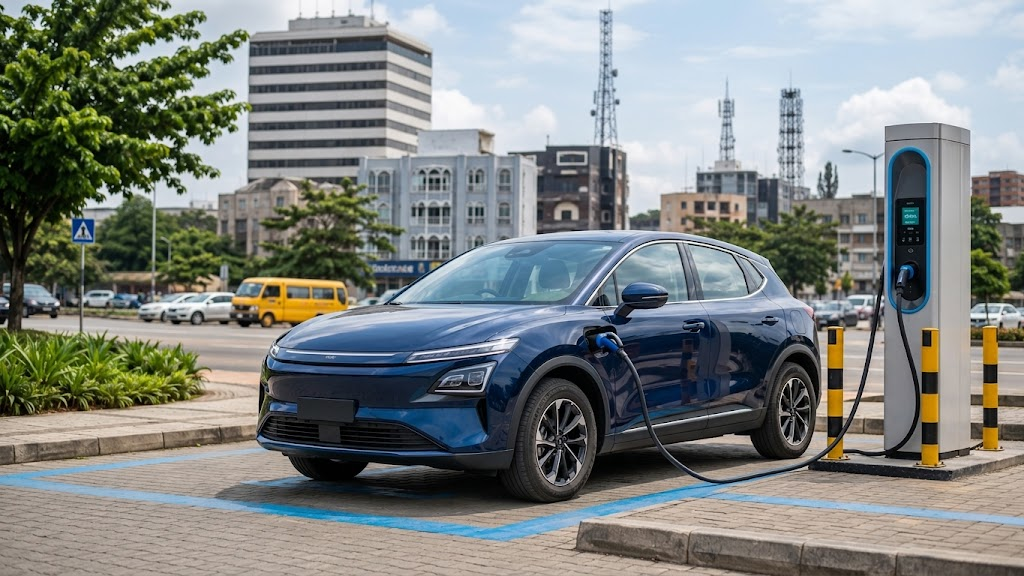
Nigeria can increase EV sales faster than it can build charging convenience. Home charging, grid upgrades, public stations and battery-swapping networks will need to grow together for adoption to move beyond early users.
Nigeria Wants More Electric Vehicles But Charging them may have created a different challenge
Electric vehicles are beginning to attract serious attention in Nigeria. But assembling and importing more EVs will not create a functioning market unless drivers can find reliable, affordable places to charge them.
Nigeria’s electric-vehicle ambitions are becoming harder to dismiss as mere conference talk. In March 2026, President Bola Tinubu expanded the mandate of the Presidential Initiative on Compressed Natural Gas to include electric vehicles. According to the official State House announcement, the renamed initiative is expected to coordinate EV development, charging infrastructure and related investment nationwide. Two months earlier, the National Automotive Design and Development Council announced an agreement involving plans for an EV manufacturing facility and charging infrastructure. The NADDC statement said the proposed plant could eventually have capacity to produce 300,000 vehicles.
These are significant signals. They suggest that electric mobility is entering Nigeria’s industrial and transport policy more seriously. But there is a practical question that could determine whether any of these ambitions reach ordinary drivers:
Where will the vehicles charge?
Buying an EV Is Only Half the Decision, a petrol car owner rarely buys a vehicle and then worries about whether fuel exists along a major route. Filling stations are already familiar, visible and widely distributed.
An EV owner must think differently. Can the vehicle charge at home, Does the building have suitable wiring and a dedicated parking space, Is electricity available for long enough, Are there chargers at work, shopping centres or major transport corridors, If a public charger is occupied or unavailable, is another one close enough to reach?
This is why charging infrastructure is not an optional extra. It is part of the vehicle’s practical usefulness. The International Energy Agency, reported that the global stock of public charging points exceeded seven million at the end of 2025. Yet it also emphasised that private charging at homes and workplaces remains important, while accessible public charging is necessary for wider adoption.
Nigeria is starting from a very different position from markets with mature charging networks. Several Nigerian universities and organisations have hosted pilot charging installations. One of the best known examples is the solar-powered station introduced through a collaboration involving NADDC and the University of Lagos. A report on the project provides a useful visual introduction.
But individual pilots do not yet amount to a dependable national network. There is currently no easily accessible, authoritative national directory showing every operational public charger, its connector type, charging speed, availability, price and maintenance status. That information gap itself is a problem: drivers cannot confidently plan journeys around infrastructure they cannot reliably locate or verify.
Nigeria’s Electricity Problem Cannot Be Ignored, charging an EV does not always require an ultra-fast public station. Many owners in established EV markets charge slowly overnight at home. Nigeria complicates that model. Unreliable grid supply means a driver may return home expecting to charge and discover that electricity is unavailable. Apartment residents may not have dedicated parking spaces or permission to install charging equipment. Some properties may require electrical upgrades before they can safely support the continuous load of vehicle charging.
Using a petrol or diesel generator to charge an EV would also weaken some of the financial and environmental advantages that attracted the driver in the first place. The challenge is not simply whether Nigeria generates enough electricity nationally. Charging demand is highly local. Several vehicles charging simultaneously can affect a neighbourhood transformer, commercial building or depot even when the wider power system has available capacity.
The IEA’s guidance on integrating EVs into electricity grids, summary explains that the effect depends on when vehicles charge, the power demanded by their chargers and the condition of the local network. Nigeria therefore needs charging development to involve electricity distribution companies, regulators, property owners, transport operators and renewable energy providers, not only vehicle manufacturers.
Solar Charging Can Help, but It Is Not Magic: Nigeria’s strong solar potential makes solar-assisted charging an attractive option. A charging site can combine solar panels, battery storage and grid electricity. Solar power can supply vehicles during the day, while batteries can store energy for periods of weak sunlight or interrupted grid supply. This approach may be particularly useful at universities, offices, shopping centres, bus depots and logistics facilities where vehicles remain parked for predictable periods.
However, solar charging still requires careful design. Fast chargers consume substantial power, and a small rooftop array cannot rapidly charge unlimited vehicles. Batteries, inverters, land, security systems and maintenance all add to the installation cost. Solar should therefore be treated as part of a properly engineered charging system not as a decorative panel placed beside a charger.
The First Big Opportunity May Not Be Private Cars: Nigeria’s EV conversation often focuses on private passenger cars, but commercial vehicles may create a stronger early market. Buses, delivery vans, motorcycles and tricycles usually follow predictable routes. Many return to the same depot or operating base each day, allowing the operator to install charging infrastructure in one controlled location. A fleet operator can calculate daily mileage, charging time and energy costs more easily than a private driver who depends on scattered public chargers.
This is particularly relevant in a country where motorcycles and tricycles support deliveries and everyday transport. Battery-swapping systems may also work for some two and three wheelers: instead of waiting for a depleted battery to recharge, the rider exchanges it for a charged one at an organised station.
The World Bank has highlighted the wider potential of electrifying two and three wheelers in African markets, although successful deployment still depends on suitable financing, durable batteries, standardisation and reliable energy. Nigeria’s charging strategy should therefore avoid assuming that every electric vehicle will be a privately owned car parked beside a suburban house.
Charging Corridors Matter More Than Random Installations, installing chargers wherever land is available would produce an impressive number on paper but a weak transport network. Locations should reflect how people actually travel. Within cities, priority sites could include offices, malls, hotels, airports, transport hubs and large residential developments. Intercity chargers need to be placed along major routes at distances compatible with the real-world range of vehicles expected to use them.
Lagos – Ibadan, Abuja – Kaduna and other heavily travelled corridors could become controlled early projects. Each site would need dependable electricity, backup supply, security, visible road access, multiple connector options and a payment system that works with Nigerian banks and mobile devices. A corridor approach would allow government and private operators to test demand before attempting nationwide expansion.
Drivers Need Standards, Not Just Stations, a charger is useful only if the vehicle can connect to it. EVs can support different physical connectors, charging speeds and communication standards. Nigeria risks importing vehicles built for several markets while installing chargers that support only some of them. Clear national standards are therefore essential.
Drivers should be able to identify:
- Which connectors a station supports
- Whether it offers slow, fast or ultra-fast charging
- Its current price per unit of electricity or charging session
- Whether it is operational and available
- Which payment methods it accepts
- Who is responsible when the equipment fails
The government should also establish safety and installation requirements for home, commercial and public chargers. Poorly installed electrical equipment could damage vehicles, overload buildings or create serious safety risks.
Announcements Must Become Measurable Infrastructure Nigeria’s Energy Transition Plan identifies transport as one of the major sectors in the country’s journey toward net-zero emissions by 2060. Its transport pathway https://energytransition.gov.ng/transports/ anticipates a major long-term shift toward electric vehicles. The direction is clear. The implementation remains the difficult part. The public should be able to track more than memoranda of understanding and proposed manufacturing capacity.
A credible national programme should publish measurable information, including:
- The number and location of operational chargers
- Charging speeds and supported connector standards
- Uptime and maintenance records
- Electricity sources and tariffs
- Installation targets and completion dates
- The institutions responsible for delivery
- Progress along priority transport corridors
Transparency would help drivers, investors and property developers plan around actual infrastructure rather than optimistic announcements.
What Should a Nigerian Driver Consider Today
For most consumers, buying an EV in Nigeria still requires more preparation than buying a conventional vehicle. Before paying, a buyer should establish:
- Where the vehicle will normally charge: Home charging is useful only when suitable parking, wiring and electricity are available.
- Which charging connector the vehicle uses: The plug must be compatible with accessible charging equipment.
- The realistic driving range: Manufacturer figures may differ from real-world performance under heavy traffic, air-conditioning use, heat and battery ageing.
- Whether the dealer provides technical support: Battery diagnostics, software support and replacement components matter as much as ordinary mechanical servicing.
- Whether regular routes have dependable charging alternatives: A charger appearing on a map is not proof that it is operational.
- The battery warranty: Buyers should understand its duration, mileage limits and exclusions.
An EV may already make sense for a household or business with dependable private charging and predictable daily travel. It is a more difficult proposition for a driver who regularly makes long intercity trips and must depend entirely on public infrastructure.
The Real Test
Nigeria does not need to reproduce another country’s charging network overnight. It needs to begin with a system suited to Nigerian realities: unreliable grid electricity, widespread apartment living, busy transport corridors, heavy commercial use and strong potential for distributed solar power. That means prioritising dependable fleet depots, workplace and residential charging, solar-and-storage installations, carefully planned highway corridors and common technical standards.
The government’s renewed EV push could create industrial investment, new technical jobs and cleaner transport. But producing or importing vehicles without building a reliable charging ecosystem would leave Nigeria with an impressive policy and an inconvenient product.
The success of Nigeria’s electric vehicle transition will not be measured only by how many EVs appear at launches or motor shows. It will be measured by whether drivers can charge them safely, affordably and without having to plan their entire lives around the next available socket.
TechView Africa verification desk
Sources & Verification
NADDC: Proposed EV manufacturing and charging-infrastructure project
State House: Expansion of the PiCNG mandate to electric vehicles
integrating EVs into electricity grids
South Africa’s Air-Traffic Agency Found Malware in Operational Technology. Here’s Why That Matters

Apple TV Arrives in Nigeria Through a ₦1,300 iCloud+ Bundle
Want to Buy Dangote Refinery Shares at ₦525? Here’s Where and How
Dangote Refinery IPO Gets SEC Approval at ₦525 Per Share

Nvidia Already Dominates AI Chips. Now It’s Buying Hugging Face for $12.9 Billion

Why Data Centres Are Becoming One of Africa’s Most Important AI Stories
WhatsApp Business Platform Charges Are Live: What Nigerian SMEs Need to Check Now
Follow TechView Africa on WhatsApp
Get TechView Africa updates on WhatsApp. Follow our channel for practical technology news, product guides and digital trends from Nigeria and across Africa.
Leave a comment
Comments cannot be edited or deleted after posting. Please review your comment before submitting.
No comments yet. Start the conversation.