

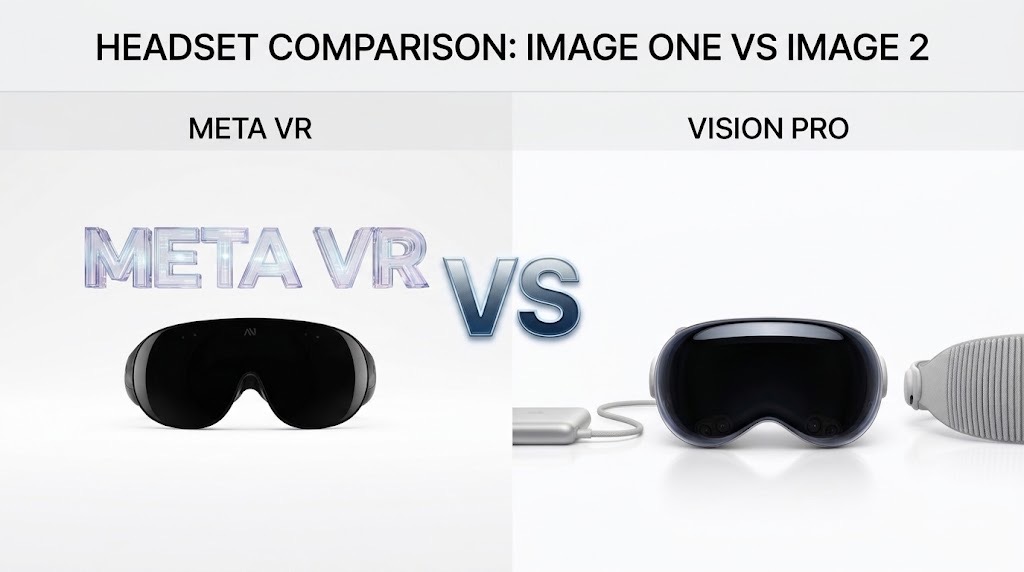
The most consequential difference is not resolution or processor speed. It is where the computer lives: Apple keeps its main computing hardware on the headset; Meta moves it into your pocket.
Meta and Apple are solving the same problem in opposite ways
Meta VR Glasses are substantially lighter and cheaper on paper: about 100g on the face and $1,299.99 when they ship in spring 2027. The current Apple Vision Pro weighs about 750–800g before its separate battery and currently costs substantially more.
But Meta achieves its weight advantage by moving compute, battery and storage into a tethered puck, while Vision Pro remains a more self-contained spatial computer with an established visionOS ecosystem. Meta has not shipped the product yet, so an overall real-world verdict would be premature.
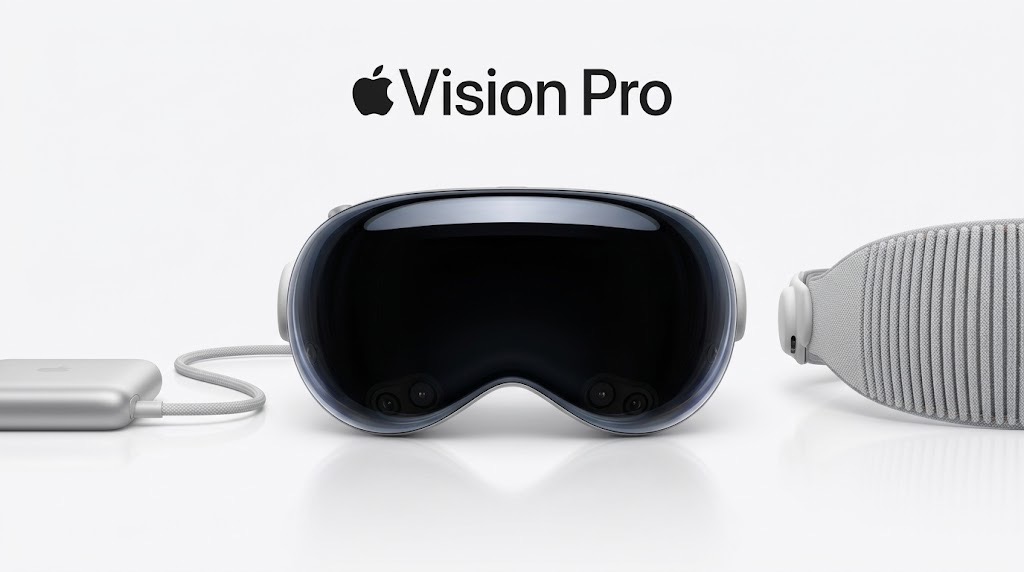
Apple Vision Pro demonstrated that eye tracking, hand input, high-resolution micro-OLED displays and virtual workspaces could make a headset behave more like a computer than a gaming accessory.
Its biggest physical compromise never disappeared: much of that computer still sits on your face.
Meta VR Glasses attack that problem directly.
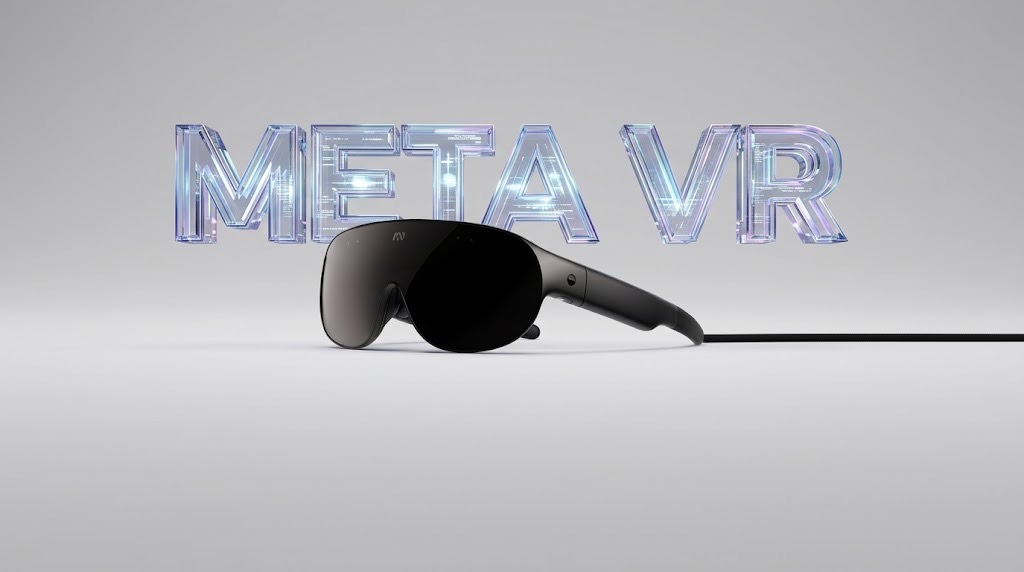
The glasses themselves contain the displays and sensors, while a tethered external puck carries the processor, battery and storage. Meta says this reduces the glasses to about 100 grams. Apple's current M5 Vision Pro weighs approximately 750–800 grams, depending on configuration, while its separate battery adds another 353 grams.
That is not merely a specification difference. It changes the entire physical design of spatial computing.
| Meta VR Glasses | Apple Vision Pro (M5) | |
|---|---|---|
| Status | Ships spring 2027 | Available now |
| US price | $1,299.99 | About $3,699 currently |
| Weight on face | ~100g | 750–800g |
| External hardware | Compute, battery and storage puck | Battery |
| Display | 2412 × 2288 per eye, micro-OLED | 23 million pixels total, micro-OLED |
| Refresh rate | Up to 120Hz | 90Hz, 96Hz, 100Hz, 120Hz |
| Meta published FOV | 70° horizontal / 66° vertical | Apple does not publish an equivalent figure |
| Primary control | Eyes and hands | Eyes, hands and voice |
| Media battery claim | Up to ~3 hours | Up to 3 hours video |
| Platform | Meta Horizon OS | visionOS |
Meta's current specifications come from its developer documentation; Apple's are from its current Vision Pro technical specifications.
Meta's 100-gram design is not magic. The weight went somewhere else
Calling the Meta device a 100-gram spatial computer can hide an important qualification.
It is really a two-part computer. Meta's puck is connected to the glasses by an optical tether and handles the Snapdragon XR2 Gen 3 processor, battery and storage. The glasses themselves handle the display and sensing hardware.
Apple already uses an external battery, but its M5 and R1 chips remain on the headset itself. The R1 processes sensor input while the M5 handles the broader computing workload.
So the comparison is not: external hardware versus no external hardware. Both have a cable.
The real distinction is: Apple moves the battery off your head. Meta moves much more of the computer off your head.
That trade-off may prove more important than another increment in display resolution if people are expected to wear spatial computers for hours.
Apple still publishes the more ambitious raw display specification
Meta's display should not be dismissed simply because the device is smaller. Its official specification lists 2412 × 2288 pixels per eye, 37 pixels per degree, micro-OLED panels and refresh rates up to 120Hz. Meta also supports Dolby Vision and Dolby Atmos.
Apple lists 23 million pixels across its two micro-OLED displays, with refresh modes reaching 120Hz. Those numbers should not be treated as directly interchangeable: total pixel count and pixels per degree measure different things.
Meta also accepts a clear optical compromise. Its official field of view is 70 degrees horizontally and 66 degrees vertically. Apple does not publish a directly comparable official FOV specification, so a clean manufacturer-to-manufacturer number cannot be provided without relying on third-party measurements.
That narrower Meta view is one of the specifications worth examining once retail hardware becomes available.
Meta already has something Apple had to build from scratch: a VR software lineage
Meta VR Glasses run Meta Horizon OS, the same platform used by Quest. Existing developers can use the same store, payment platform and SDK family, although interfaces need to adapt to the glasses' eye-and-hand-first controls.
Meta says more than 75 games will be playable using hand gestures at launch, while Xbox Cloud Gaming can provide access to hundreds more. It is also positioning the glasses around IMAX Enhanced movies, 3D content and more than 100 immersive live sporting events annually.
Apple's advantage is different. Vision Pro sits inside Apple's existing computing ecosystem. Mac Virtual Display can turn a compatible Mac into a virtual screen inside Vision Pro, including wide and ultrawide layouts, while visionOS provides native applications alongside compatible software. That creates two different platform identities:
Meta: VR, entertainment, gaming and spatial computing converging.
Apple: personal computing, media and the Mac ecosystem expanding into spatial interfaces.
The price difference changes who can realistically consider either device
Meta says VR Glasses will launch at $1,299.99. The current US price of Vision Pro is approximately $3,699, following Apple's 2026 price increase.
That makes Meta roughly $2,399 cheaper, or about 65% below the current Vision Pro starting price.
It still is not a mass-market price. $1,300 remains expensive for a device whose usefulness beyond entertainment and specialist work will have to be demonstrated. But the difference changes the comparison from two similarly exclusive experiments into products occupying noticeably different price tiers.
Nigerian buyers face another problem: neither device has a proper Nigerian retail story
Price comparisons become less straightforward once the devices cross into Nigeria. Apple's official Vision Pro availability currently covers markets including the US, UK, UAE, Canada, France, Germany, Japan, Singapore, South Korea and several Asian markets but not Nigeria. Apple also warns that support is only available in countries where Vision Pro is officially sold and that some content and account functionality can depend on the buyer's region.
Meta has announced its spring 2027 launch and US price but has not yet provided a Nigerian price or confirmed Nigerian availability in its launch announcement.
For Nigerian buyers, that means eventual grey-market availability should not be confused with official support. Imported hardware can introduce additional questions around:
- warranty;
- replacement parts;
- prescription lens inserts;
- account region;
- streaming availability;
- subscriptions;
- accessories;
- and repair support.
This is the same distinction TechView Africa has found repeatedly with imported consumer hardware: a product working in Nigeria is not the same thing as Nigeria being an officially supported market.
TVA has also examined the wider privacy implications of increasingly discreet wearable technology in Smart Glasses Can Record the People Around You: What Privacy Rights Do Bystanders Have?.
Meta has solved one Vision Pro problem. It has not proved the whole product yet
The strongest argument for Meta VR Glasses is easy to understand without wearing them. Putting roughly 100 grams on someone's face is very different from putting 750–800 grams there.
The $1,299.99 price is also fundamentally different from approximately $3,699. But the device remains pre-release.
Meta still has to demonstrate that the narrower field of view, tethered puck, thermal behaviour, battery performance, software reliability and long-session comfort work as promised in finished retail hardware.
Apple's Vision Pro has the opposite advantage: its compromises are already measurable because people can actually buy and use it.
The more interesting question, therefore, is not whether Meta has already beaten Vision Pro. It is whether Meta has identified the hardware architecture that makes spatial computing easier to live with.
Our Recommendation
Treat Meta VR Glasses as the more interesting design direction, not yet the proven better product.
Meta's decision to move compute, battery and storage away from the face directly addresses two of the largest barriers surrounding premium spatial computing: weight and price. Apple still offers a shipping product, deeper Mac integration and a mature visionOS experience.
For Nigerian buyers, neither warrants an import decision yet without checking regional support. Vision Pro remains unsupported officially in Nigeria, while Meta has not confirmed Nigerian availability for VR Glasses.
The comparison becomes much more meaningful once Meta's production hardware ships in 2027 and its comfort, display trade-offs and software experience can be tested rather than inferred from specifications.
Sources & Verification
Meta — Introducing Meta VR Glasses
Meta Developers — Meta VR Glasses Technical Specifications
Meta Developers — Building for Meta VR Glasses
Apple — Vision Pro Technical Specifications
Apple Support — Vision Pro M5 Specifications
Apple Support — Mac Virtual Display on Vision Pro
Apple — Buy Vision Pro and International Availability Guidance
Frequently asked questions
How much cheaper are Meta VR Glasses than Apple Vision Pro?
Meta says its VR Glasses will launch at $1,299.99, while the current Apple Vision Pro costs about $3,699 in the US. That puts Meta’s announced price roughly $2,400 lower, although the Meta device has not yet shipped.
Why are Meta VR Glasses so much lighter than Apple Vision Pro?
Meta moves the processor, battery and storage into a separate tethered puck, leaving only about 100 grams on the wearer’s face. Apple also uses an external battery, but its main M5 and R1 computing hardware remain inside the headset. Do Meta VR Glasses have a wider field of view than Apple Vision Pro?
Can I buy Meta VR Glasses or Apple Vision Pro officially in Nigeria?
Apple Vision Pro is not currently officially sold in Nigeria. Meta has announced a spring 2027 launch for VR Glasses but has not confirmed Nigerian availability or pricing. Imported units may still work, but official support, warranty and regional services can differ.
Which is better for gaming: Meta VR Glasses or Apple Vision Pro?
Meta is positioning VR Glasses more heavily around gaming and immersive entertainment through Horizon OS, hand tracking and access to compatible titles. Vision Pro is more closely tied to Apple’s productivity, media and Mac ecosystem. A final gaming comparison should wait until Meta’s retail hardware actually ships.
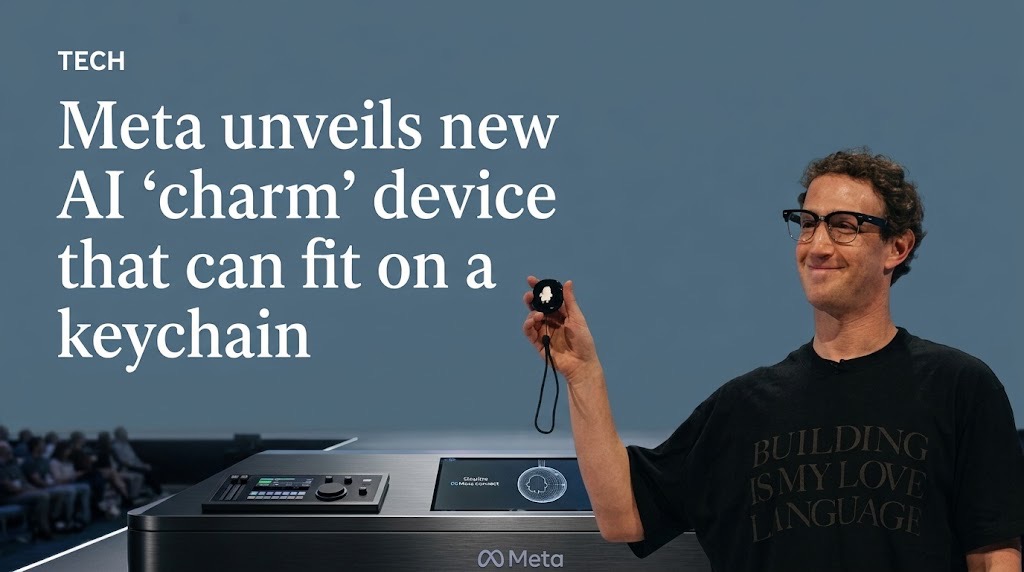
Meta Charm Has Its Own 5G Connection. What Can It Do That Your Phone Cannot?
Best Affordable Smartwatches for Notifications and Basic Fitness Tracking
Best Affordable Earbuds for Clear Calls in Noisy Places
Best Budget Tripods and Gimbals for Shooting Better Phone Videos
Apple Watch, Galaxy Watch and Pixel Watch in Nigeria: Which Health Features Are Actually Available?
Smart Glasses Can Record the People Around You. What Privacy Rights Do Bystanders Have?
20,000mAh on the Box, Far Less at the USB Port: What African Buyers Should Know About Power Banks
Follow TechView Africa on WhatsApp
Get TechView Africa updates on WhatsApp. Follow our channel for practical technology news, product guides and digital trends from Nigeria and across Africa.
Leave a comment
Comments cannot be edited or deleted after posting. Please review your comment before submitting.
No comments yet. Start the conversation.